
A Washington wind map for 80m
December 8, 2011 by Paul Dvorak
Filed under Environmental Issues, Site assessments, Wind Basics, Wind Power News

The chart (right of the map) shows the wind-resource potential above a given gross capacity factor at 80-m and 100-m heights for Washington.
The Department of Energy’s Wind Program and the National Renewable Energy Laboratory (NREL) has published a wind resource map for the state of Washington. The resource map shows the predicted mean annual wind speeds at 80-m height. Presented at a spatial resolution of about 2 km (interpolated to a finer scale for display). Areas with annual average wind speeds about 6.5 m/s and greater at 80-m height are generally considered to have suitable wind resource for wind development.
Additionally, a national dataset was produced of estimated gross capacity factor (not adjusted for losses) at a spatial resolution of 200 m and heights of 80 m and 100 m. Using AWS Truepower’s gross-capacity factors, NREL estimated the windy land area and wind energy potential in various capacity factor ranges for each state. The table lists the estimates of windy land area with a gross capacity of 30% and greater at 80-m height and the wind energy potential from development of the “available” windy land area after exclusions.
The Installed Capacity is the potential megawatts (MW) of rated capacity that could be installed on the available windy land area, and Annual Generation is the estimated annual wind energy generation in gigawatt-hours (GWh) that could be produced from the installed capacity. NREL reduced the wind potential estimates by excluding areas unlikely to be developed such as wilderness areas, parks, urban areas, and water features (see Wind Resource Exclusion Table for more detail). Additional wind potential tables are included for various capacity factor ranges.
The accompanying chart (left of the map) shows the wind-resource potential above a given gross capacity factor at 80-m and 100-m heights for Washington.
These maps and wind potential estimates come from a collaborative project between the National Renewable Energy Laboratory and AWS Truepower of Albany, New York. This is the first comprehensive update of the wind energy potential by state since 1993. NREL has worked with AWS Truepower for almost a decade updating wind resource maps for 36 states and producing validated maps for 50-meter height above ground. U.S. Department of Energy’s Wind Powering America project supported the mapping efforts.
NREL
www.nrel.gov
AWS Truepower
www.AWStruepower.com
An NREL director’s statement to energy leaders
June 16, 2011 by Paul Dvorak
Filed under Policy, Wind Power News
Renewable energy is conventional energy and it is ready for wider use. This statement and others come from the remarks of Dr. Dan Arvizu, Director, National Renewable Energy Laboratory delivered at the 2011 EnergyBiz Leadership Forum, Washington, D.C.

Dr. Dan Arvizu
When I first read the title of this panel discussion, it occurred to me there’s something of a disconnect between those of us who work in the field of renewable energy, and others who are focused solely on so-called conventional energy. Given that renewables are still viewed by some as in something of a separate category, somehow apart from the rest of the energy industry, I guess it’s no surprise that we still get questions along the lines of, “When will renewable energy be ready for prime time?”
My answer to that question is that renewable energy is already for prime time … today.
Less than 10% of electricity generation comes from renewable energy. That’s 130 GW and only 53 GW of that is from sources other than hydroelectricity.
Though it may come as a surprise to some, in the United States today, the non-hydro renewable energy we generate is nearly equal to the energy we get from all of U.S. offshore oil production. Renewable power — that is wind, solar, geothermal and biomass — currently supplies 160,000 GWh of electricity generation in the U.S. If we add renewable hydroelectric power, we obtain 430,000 GW-hours of clean, renewable electricity annually.
If we were to calculate the amount of energy we get from offshore oil, the 683 million barrels of offshore oil we produce is about equal in energy equivalency to what we currently get from renewables.
So while renewable energy — excluding hydropower — has historically been seen as filling a limited, niche market, it has been growing rapidly in recent years. The installed renewable energy capacity both around the world, and in the United States, more than tripled between 2000 and 2009.
In the United States, renewable energy technologies have been capturing a greater and greater share of newly installed generation. In 2009, renewable energy accounted for more than 55% of all new electrical capacity installations. That’s a huge change from just five years earlier, when all new renewable energy systems equaled just 2% of new capacity additions.
That’s the good news. The less good news is that we may be on the verge of making the same mistake we have in the past when it comes to new energy opportunities. Cuts have been proposed to the R&D programs of the Department of Energy that would devastate wind, solar, biofuels, geothermal, hydrogen, energy efficiency and a host of other promising new technology development programs.
I have to say that I fully support, and we all should support, the need to confront deficit spending. But cuts that approach 30, 40%, or more, of our R&D budgets, that most informed advisers would suggest are already grossly underfunded, would be incredibly short sighted. Indeed these cuts would be wasteful of the progress and momentum established by previous recent investments. Such cuts to serious programs would have devastating effects to valuable research endeavors. They would set back by years, if not decades, the time when we get to reap the real benefits of energy research investments we’ve already made.
The critical issue before the nation looms as large now as ever: Can we afford to abandon our efforts to find new, cost effective, clean energy technologies at a time when oil prices have climbed precipitously to $100 a barrel? With some predicting they will rise further to $140 a barrel oil in the near future? With oil imports climbing toward 70% of U.S. consumption, while a number of the nations on which we depend for oil are reeling under unprecedented political instability and uncertainty? With the need to move to sustainable, clean energy resources becoming more imperative with each passing day?
Further complicating the current situation, a number of misconceptions have clouded the perceived value and role of applied energy science. The assumption is that federal R&D can limit itself to long-term science, without regard to how and when, or even if, a commercial product results.
That position begs the question: Do we as a nation have a need for the benefits of new energy technology in the near term? Today, tomorrow, or in the next few years? The answer, I would assert, is that we unequivocally, absolutely do need these benefits.
I understand and support the idea that fundamental science is, in fact, fundamental. That we do need to embark on long-range science-based initiatives that will yield new, beneficial technologies years and decades down the road.
But our nation also has more immediate needs. Our nation will benefit tremendously if we can move the technologies that have already been developed, enable the private sector to do the necessary remaining work it takes to conceptualize those technologies into products and systems, and make certain that those technologies result in commercialized products that can create sustainable, job creating, businesses in the marketplace. The private sector is best able to move technology down learning curves and drive the costs to a competitive position in the market. But, government must help.
In real terms, what applied energy science does is reduce the acceptable risk of investing in new technology, so that companies and the venture capital community can have the confidence they need to adequately invest in those new technologies. What we at NREL and other applied science laboratories bring to the table are world-leading expertise, tools and experience in bringing the most promising technology into the real world. We need to address not just the science, but the full life-cycle impacts of the R&D we undertake.
Let me emphasize that this is not a matter of undercutting long-term science to the benefit of applied energy research. Because we need both, it really is a matter of balancing the federal research portfolio to maximize the impact of new technology — to get it to commercialization sooner, where it can impact the market and contribute in real ways to the nation’s crucial energy needs.
For those of us in the business of using applied science to create new clean energy options, this is not an abstract concept. Working with industry on cutting through real-world barriers to innovation is what we’re about.
For instance, the laboratory I lead, the National Renewable Energy Laboratory, today is working with more than 350 separate companies, from industry mainstays, to entrepreneurial start-ups. For the 133 Cooperative Research and Development Agreements at NREL in FY10 alone, we have invested $50 million of Department of Energy shared resources in these agreements to attract more than $60 million of funds in cost share and $250 million of shared resources — that’s 6 to 1 leverage! Since our institution began more than 30 years ago, our work in applied energy science has put us at the pivotal center of each of the emerging clean energy industries. And we remain a vital resource even as these growing industries gain some maturity.
In the field of solar PV, for instance, NREL’s National Center for Photovoltaics has been working with some 75 different companies. They include Ampulse, a rising up-start — a venture-capital-supported firm with a new thin-film technology that could drastically reduce costs and improve PV efficiencies by taking novel substrate material developed at Oak Ridge National Laboratory for high temperature superconducting wire and a novel hot wire deposition process from NREL to develop a new class of PV material. And our partnerships extend all the way to First Solar, the largest PV manufacturer in the United States, which has a decade-long history of working with NREL on thin-film technology pioneered in the DOE program.
On the biofuels front, our active collaborations with leading industry partners have put us on the verge of reaching our primary goal: that of producing cellulosic ethanol at a cost that will be price-competitive with corn ethanol, and eventually gasoline. This next-generation ethanol technology has many environmental and carbon-reduction advantages over corn ethanol, and ends the fuel-vs-food debate that surrounds use of corn grain as a feedstock.
Each of these examples demonstrate the value of applied energy science. It’s using R&D to solve today’s energy problems, and create new solutions for our energy future.
Federal support for applied energy science is in no way a partisan issue — nor should it be made into one. The rationale for, and the benefits from, clean energy research and development remain as strong, relevant and as compelling as ever — political ideology notwithstanding. We’ve been fortunate to have strong bipartisan support throughout our history, and are optimistic that will continue.
We are also optimistic about our continued contributions in the future — in part because we know what a focused R&D program has accomplished in the past. Looking at the real price for a unit of energy produced, solar, wind, biofuels and other renewables cost where from 70 to 90% less than they did when the federal research effort began in the early 1980s.
And we know applied energy science remains relevant to the issues that confront our nation today. If you consider the economic recession and the need for job creation as the most pressing issues before the nation, then clean energy R&D should be a priority. If you’re seeking ways to increase our nation’s economic competitiveness, then clean energy research should be on top of your list as well.
And, if you are looking to strengthen U.S. energy independence, and reduce our reliance on imported oil — while at the same time achieving the benefits to national security and improved balance of trade that would go along with those goals — then clean energy research is again one of the best policy options we have available to us.
To have the energy options we need will require innovation through research and development on multiple technology pathways. This long-term clean energy R&D portfolio must include cellulosic ethanol, biodiesel, fuels produced from algae, renewably produced hydrogen, solar, wind and geothermal power, new battery and other energy storage systems, and of course, energy efficiency technologies as well.
And I can attest, that after more than three decades of observing innovation in the laboratory, that there are more exciting innovations in the lab today than ever before — and this is not the time to retreat on our investments in our energy future!
Thank you.
NREL
www.nrel.gov
NREL ranks utility power programs
May 13, 2011 by Kathleen Zipp
Filed under Policy

The U.S. Department of Energy’s (DOE) National Renewable Energy Laboratory (NREL) has released its annual assessment of leading utility green-power programs. Under these voluntary programs, consumers can choose to help support additional electricity production from renewable resources such as wind and solar.
Green power sales from utility programs exceeded 6 million MWh in 2010. Wind energy now represents more than three-fourths of electricity generated for green energy programs nationwide. Using information provided by utilities, NREL has developed “Top 10″ rankings of utility green power programs for 2010 in the following categories:
-total sales of renewable energy to program participants
-total number of customer participants
-the percentage of customer participation
-green power sales as a percentage of total utility retail electricity sales
-the lowest price premium charged for a green power program using new renewable resources.
According to NREL, more than 850 utilities across the United States offer green power programs. Ranked by renewable energy sales (kWh/year), Austin Energy in Austin, Texas sold the largest amount of renewable energy in the nation through its voluntary green power program. Rounding out the top five are Portland General Electric (Oregon), PacifiCorp (Oregon and five other states), the Sacramento Municipal Utility District (California), and Xcel Energy (Colorado, Minnesota, Wisconsin and New Mexico).
Ranked by the percentage of customer participation, the top utilities are City of Palo Alto Utilities (California), with more than 20 percent of its customers participating in its green power program, followed by Portland General Electric, Farmers Electric Cooperative of Kalona (Iowa), Madison Gas and Electric Company (Wisconsin), and the Sacramento Municipal Utility District.
“Participating in utility green power programs is one way that consumers can support renewable energy development. These utilities are the national leaders,” says NREL senior analyst Lori Bird. Utility green pricing programs are one segment of a larger green power marketing industry that counts approximately 1.5 million customers, including Fortune 500 companies, government agencies, and colleges and universities among its customers, and helps support more than 9,000 MW of renewable electricity generation capacity.
NREL has also found that more utilities are developing community solar programs, an innovative program design that enables consumers to support local projects. Community solar programs allow customers to purchase a share of a solar system developed in their community and receive the benefits of the energy that is produced by their share. Typically, consumers will pay an upfront cost per watt of solar, and then receive a credit on their bill for the kilowatt-hours that their purchase generated.
“Utilities and third-parties are increasingly developing community solar programs as one way to support local renewable energy development,” says NREL analyst Jenny Sumner. “Customers can invest in solar through community solar programs even if they are renters or own homes with shaded roofs.”
See complete ranking at NREL.gov
Study to detailed airflow through wind farm
April 30, 2011 by Paul Dvorak
Filed under Environmental Issues, Site assessments, Wind Power News

These are a few of NREL's test turbines at it's facility near Boulder Colo.
To improve wind farm energy production, NOAA (National Oceanic and Atmospheric Administration) researchers are launching a study to make visible the invisible “wakes” produced behind wind turbines. Wind-farm designs have long known that wind turbine rotors generate ripples, waves, and other atmospheric disturbances downstream of turbines. “The turbulence can damage turbines downstream, and harm productivity,” said Bob Banta, an atmospheric scientist with NOAA’s (ESRL) in Boulder, Colo.
Banta and colleagues from ESRL, the (CU) at Boulder, the U.S. Department of Energy’s National Renewable Energy Laboratory, and Lawrence Livermore National Laboratory have set up an experiment south of Boulder to create 3D portraits of wind speeds and directions in turbine wakes.
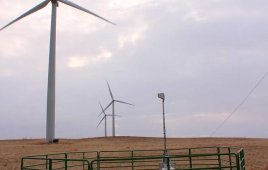
Wind turbines —some with rotor tips that reach up 150m— stand ready to harness wind energy at NREL’s. The prevailing winds sweep east over the mountains and are funneled through Boulder’s Eldorado Canyon, right to the Wind Technology Center. “The wake effect has been modeled in wind tunnel studies and numerical models,” Banta said, “but the atmosphere is different, it’s more variable and complicated.” Banta spent the last several years using a high resolution scanning Doppler lidar to make detailed profiles of the atmosphere. For the turbine project, he wants to capture turbulence and other wake effects in a broad wedge of air up to 7-km long and 1-km up. The team will use the scanning lidar to take a detailed look at the atmosphere in front of and behind one of the large turbines on the NREL site: a 2.3-MW unit with a 100 m hub height, and a 95-m rotor dia.

The reading from a lidar, taken May 14, 1996, shows a range-time display of vertical profiles of the vertical wind acquired by HRDL in Boulder during tests. Positive velocities indicate rising air. The column of high negative velocity between 19:10 and 19:12 is a shaft of light rain. The simultaneous 30-m range resolution and 5-cm velocity resolution are unprecedented for a high repetition rate coherent Doppler lidar.
The researchers hope to capture ramp up and ramp-down events — winds suddenly gusting and abating. They will also gather data on what happens downstream when winds quickly shift directions. Other instruments will support the project, such as the “CU Windcube lidar” that measures wind speeds, directions, and turbulence in the lower atmosphere, and meteorological instruments on towers downwind.
“Current-generation wind turbines reach into a complicated part of the atmosphere,” said Julie Lundquist, project leader, professor in the Department of Atmospheric and Oceanic Sciences at CU-Boulder and a joint appointee at NREL. “If we can understand how gusts and rapid changes in wind direction affect turbine operations and how turbine wakes behave, we can improve design standards, increase efficiency, and reduce the cost of energy.”
Wind power now provides 2.3% of U.S. electricity. To facilitate increased electricity production from wind, its important to better understand the turbulent lower atmosphere and its effects on turbines and turbine arrays.
The wind wake study, the Turbine Wake and Inflow Characterization Study, fits under a Memorandum of Understanding on “Weather-dependent and Oceanic Renewable Energy Resources” signed by NOAA and the DOE in January 2011. The agreement sets up a framework for NOAA and DOE to work together on enhancing the accuracy and completeness of resource information for the effective and sustainable deployment, operation and maintenance, and the efficient use of weather-dependent and oceanic renewable energy technologies and infrastructure. The wind wake study was primarily funded by DOE, NOAA and CU-Boulder and involves a team led by:
- Robert Banta and Alan Brewer, Chemical Sciences Division, ESRL
- Yelena Pichugina, Cooperative Institute for Research in Environmental Sciences
- Julie Lundquist, CU-Boulder, NREL National Wind Technology Center
- Neil Kelley, NREL National Wind Technology Center, and
- Jeff Mirocha, Lawrence Livermore National Laboratory
NOAA’s mission is to understand and predict changes in the Earth’s environment, from the depths of the ocean to the surface of the sun, and to conserve and manage our coastal and marine resources.
Noaa.gov
NREL study says wind could bring in big dough
February 18, 2011 by Windpower Engineering
Filed under Wind Watch
Wind could do great things to boost Wyoming’s economy, according to a recent NREL study. Analysts there have examined the economic impact of wind development in the state, on behalf of the Wyoming infrastructure Authority. The study considered factors such as power line construction and the growth of natural gas power production used to back up wind energy sources. According to analysts, this development would create 47,000 jobs and provide $2.6 billion in wages and benefits. Over all, the development could add as much as $5.1 billion to state’s economy.
Researchers expect wind jobs, wages, and spending to peak in 2016 and again 2019. However, as projects phase into normal operations the economic impact will flatten out. Also, when considering construction and 20 years of operation, wind energy investments could boost the state’s economy to between $12 billion and $15 billion. Bottom line: there is certainly potential for in-state manufacturing, education, and job training.
Hydrogen bus lets lab visitors ride the future
January 19, 2011 by Paul Dvorak
Filed under Power storage, Wind Power News

NREL's shuttle can run 175 to 250 miles (depending on use) before refueling. The lab has outfitted its hydrogen dispensing station with cascading storage tanks which minimize refueling time.
DOE recently funded the leases for 12 hydrogen-powered shuttle buses to demonstrate market-ready advanced technology vehicles. NREL was the first facility to receive one of the leased buses which it uses on its Golden, Colo. campus for site tours. The shuttle buses are being placed at federal facilities across the country to demonstrate market-ready advanced technology vehicles.
“NREL’s twist to this demonstration is that we are fueling our shuttle bus with hydrogen made from wind energy at our National Wind Technology Center near Boulder,” says Hydrogen Technologies & Systems Director Robert Remick. “So the hydrogen in our shuttle was provided by wind blowing off the Rocky Mountains last week.”
The hydrogen internal-combustion engine (H2ICE) bus in use at NREL was manufactured by Ford, one of the first automakers to develop commercially available H2ICEs. The shuttle uses a conventional gasoline-powered engine but runs on the hydrogen generated at NREL’s Wind to Hydrogen (Wind2H2) Project. It links wind turbines to electrolyzers, which pass the wind-generated electricity through water to split it into hydrogen and oxygen. The hydrogen is stored and used later to generate electricity from an internal combustion engine or a fuel cell.
The bus has a 6.8-liter supercharged Triton V-10 engine. A few design adjustments were needed to switch the basic gasoline-powered engine to one powered by hydrogen. Modifications included specially designed spark plugs, alternate materials for valve seats, and other parts that may become brittle when exposed to hydrogen.

A tech inpsects the Proton Energy System's electrolyzer that is powered by wind.
NREL says its shuttle is up to 25% more efficient than similar gasoline-fueled vans and can run 175 to 250 miles before refueling. The lab has outfitted its hydrogen dispensing station with cascading storage tanks, which decreases the time required for refueling. This is particularly beneficial for vehicles with large onboard storage systems like the H2ICE bus, which can take up to 66 lb of hydrogen in a single fueling. Because NREL’s fueling station has a 286-lb storage capacity at 6,000 psi, filling the bus takes 20 to 30 min. Refueling would take less time at other commercial hydrogen stations.
“We are also storing more than 440 lb of hydrogen at the Wind2H2 site,” says Keith Wipke, NREL Senior Engineer and Group Manager for Hydrogen Analysis. “It lets us capture intermittent renewable energy, fuel the vehicle, and put energy back on the grid at times when there is high electricity demand.”
Fuel cells, however, are the most efficient way to use hydrogen in vehicles. Although the bus uses an internal combustion engine, it is a good step to get the technology into the market and provide an alternative to fleets while the infrastructure for hydrogen fueling stations develops.”
Such stations are springing up across the U.S., with about 60 already in operation and 20 more slated for construction. “The recession has caused a bit of a delay, but California recently awarded funding for 11 new fueling stations, and this is on top of seven new stations under construction,” says Wipke.
He expects hydrogen vehicles to claim a piece of the personal car market. DOE set a target goal for hydrogen fuel-cell passenger vehicles to hit the market in 2015 and many of the major players — GM, Daimler, Honda, Toyota, Nissan, and Hyundai-Kia —are targeting a 2015 launch for larger hydrogen fuel-cell entries. The DOE recently announced that 70 Mercedes Benz B-Class fuel cell vehicles will be deployed in California by 2012.
“Look at the auto industry after this recession. The fact that hydrogen is still strong is a huge vote of confidence for the technology,” says Wipke.
The benefits to hydrogen powered vehicles include low tailpipe emissions, increased economic competitiveness, and jobs in the U.S.
Wipke believes that although fuel cell cars may start out as a small part of the passenger vehicle market, they won’t be relegated to niche-market status. Consumers will be able to purchase fuel cell vehicles that can go up to 300 miles on a single fill-up and refuel in three to five minutes. Drivers seeking larger multi-purpose vehicles, such as trucks and SUVs, will also be able to tow trailers and recreational equipment using fuel-cell vehicles.
Fun hydrogen facts to know and tell
- Hydrogen can be made from a wide variety of domestic, renewable resources such as solar, wind, biomass, and geothermal energy.
- Enough hydrogen is produced in the U.S. every year to fuel 34 million fuel cell vehicles. Hydrogen is used primarily for commercial purposes such as cleaning up gasoline and processing certain foods.
- Hydrogen is neither more nor less hazardous than more common fuels like natural gas, propane, or gasoline.
- Compared to conventional gasoline engines, hydrogen powered engines have low criteria emissions when the hydrogen is produced from renewable resources.
- Only modest design modifications to standard combustion engines are needed, so the engine technology is familiar to mechanics and fleet personnel.
- With few cost and technical issues limiting commercialization and deployment, H2ICE vehicles can help create demand needed to support the build out of a hydrogen infrastructure.
NREL analysts noted in a 2007 report, “Potential for Hydrogen Production from Key Renewable Resources in the United States,” that about 1 billion metric tons of hydrogen could be produced annually from wind, solar, and biomass resources in the U.S. with potential to displace gasoline consumption in most U.S. states.
NREL’s research in hydrogen and fuel cells will get a boost in the coming years as a new laboratory — the Energy Systems Integration Facility (ESIF) comes online in 2012 and provides new lab space for hydrogen and fuel-cell-related research.
“We are also looking to do more research on fuel cell vehicles as manufacturers get ready to launch their next line of demonstration cars. We will be able to demonstrate the path of source renewable energy all the way through to the vehicle.”
National Renewable Energy Lab
www.nrel.gov
Wind Turbines Whip Up Excitement, School Pride
November 29, 2010 by Kathleen Zipp
Filed under Wind Power Projects, Wind Turbine Installation

Blades of a Southwest Windpower Skystream turbine are silhouetted by the sun at NREL's National Wind Technology Center. Forty-two of the turbines are spinning at schools in 11 states as part of the Wind for Schools project. Credit: Dennis Schroeder
The U.S. National Renewable Energy Laboratory’s (NREL) Wind for Schools project is churning, having installed 42 Southwest Windpower SkyStream 3.7 turbines so far, with a goal of five new turbines each year for the 11 states already part of the program. Eventually, 35 states are expected to participate.
That’s enough critical mass, say the researchers, for the idea to catch fire, and for states and school districts to take on the installations themselves. And when that happens, NREL says there will be such a groundswell of informed eagerness for wind energy among young people that the fear of shortages of skilled labor for the wind industry might subside.
“It’s a great fit for our area in that wind is something we deal with all of our lives around here,” Kyle Hebberd, superintendent at the Walsh School District in southeast Colorado, said at the dedication ceremonies for the wind turbine at Walsh High School. “It’s great to see it finally put to some productive use.”
The students at Walsh walk by their wind turbine every day, get some of their electricity from it, and can incorporate the energy data into their math and science classes. More than that, the turbine at the high school blows excitement all over town.
Turbines Educate, Point to Future Job
This month, the students in the upper grades at Walsh Elementary School are crafting their own mini-turbines in what Chenoweth

NREL senior engineer Becki Meadows presents a check from the National Renewable Energy Laboratory to Walsh Superintendent Kyle Hebberd for green energy credits from the school's wind turbine. Walsh is one of 42 schools that installed a wind turbine through the Department of Energy's Winds for Schools project. Credit: Becki Meadows
calls the Blade Challenge. It’s embryonic in Colorado, but huge in Maine, where more than a dozen high schools compete to design blades that will create the most power.
Janet Chenoweth, who teaches science to fourth-, fifth-, and sixth-graders, became a Wind Senator through the KidWind project and is becoming an ambassador for wind-energy curriculum in southeast Colorado.
“Oh my gosh, they’re excited,” Chenoweth said. “Ever since the wind turbine went up there, my kids have been saying, ‘When can we do wind energy?’ If we can get them excited over here, the science teachers in the high school can take it from there.”
The idea began in Colorado, where NREL has its headquarters.
“We used rural Colorado as our sandbox to see what rural school officials were interested in,” said NREL engineer Larry Flowers, the National Technical Director of Wind Powering America.
After meeting several times with rural officials, “We decided a simple, low-cost package with a curriculum, sited and installed in collaboration with university engineering students and the local electric co-op was the ticket.”
NREL Director Dan Arvizu agreed to buy green energy certificates for the projects as part of NREL’s sustainability program.
Colorado Gov. Bill Ritter said the school wind turbine projects are an important example of how Colorado is participating in the “New Energy Economy.”
“Educating today’s young people about the benefits and mechanics of renewable energy prepares them for a wealth of future opportunities,” Ritter said. He said the Wind in Schools program also demonstrates the crucial role rural communities can play.
“It’s a great way to introduce wind energy to communities in a not very threatening, educational way,” said Ian Baring-Gould, senior research supervisor for wind technology deployment at NREL’s National Wind Technology Center. “It allows the community to take a more active role in their energy future.”
It needs to happen because the Department of Energy (DOE) envisions the United States getting as much as 20% of its electricity from wind power by 2030, the year today’s toddlers graduate from college, eager to establish careers in forward-looking industries.
The DOE expects 500,000 wind-related jobs by 2030 if the 20% scenario comes to pass. That would be a six-fold increase in wind-related jobs from today.

Students and a teacher at Jerome Middle School in Jerome, Idaho, surround a 12-foot-diameter rotor blade prior to it being installed on a turbine that now rises about 45 feet above their school yard. Credit: Stephanie Lively
Wind Turbine Pride Contagious in Rural Areas
The idea is to make the wind turbines points of community pride, especially in rural areas. The rural electric companies that brought electricity to the towns are enthusiastically helping to sponsor the installations. Wind energy can be a way to keep young adults in town, with the prospects of interesting jobs, rather than seeing them flee to the cities.
Once a school gets a turbine, the school down the road wants one, and so do the local car dealership and other businesses.
In late January, NREL and the DOE’s Wind and Water Power Program announced that five more states had been selected to receive $60,000 each in support of the Wind Powering America’s Wind for Schools Project
In each state, university students will help install the turbines and deliver lessons to younger students through local Wind Applications Centers. The new partnerships are: Appalachian State University in North Carolina; James Madison University in Virginia; Northern Arizona University; Pennsylvania State University and the University of Alaska. The original six states are Colorado, Idaho, Kansas, Montana, Nebraska and South Dakota.
“What this program is addressing is the bottleneck in brainpower,” said Todd Haynes, Boise State University’s Wind for Schools coordinator. “That’s why wind in the schools is all about education.”
Schoolyard Turbines a Symbol of Future Employment
Wind Powering America is about renewable energy, but it’s also about jobs.
“We had identified the need for a skilled workforce” for wind energy even before DOE’s 20% by 2030 Report of two years ago, Baring-Gould said.
“We’re really talking about a paradigm shift” with the expected surge in wind energy, Baring-Gould said. “The last time we went from zero to a significant amount was with nuclear energy in the 1950s and 1960s.”
Ian-Gould notes that there are universities with huge programs devoted to nuclear energy, but nothing comparable for wind energy.
With fewer middle-school students expressing an interest in science, the prospects of there being enough skilled young adults to enter the growing wind-energy field, was looking like “a train wreck,” he said.
So, the idea of Wind Application Centers at land-grant universities was born. College students would take classes in wind applications, then be assigned to elementary or secondary schools where they would oversee the installations and talk to pupils about wind energy.
“We’re kind of feeding the pipeline, training engineers and getting the kids to think about science,” Baring-Gould said.
The 2.5-kilowatt turbines, with rotor blades 12 feet in diameter, are big enough to power about a third of the electricity needed for a single-family home, so they produce just a slice of what a school needs.
Still, they generate about $400 worth of electricity a year and in about five years can offset the $2,000 the school is asked to contribute to the upfront costs of the turbine.
Turbines Propel Classroom Excitement
The school gets more than green power. There are a curriculum on wind energy and a guide for the classroom teachers. And, data from the turbines is online, giving the teachers and students a chance to play with the numbers in nearly real time.
“How much energy did the turbine produce last night?” students will ask in the spirit of intra-town competition. “Did we produce more energy than they did?”
The mania is already on display.
Zach Parker let the middle-school students “turn the wrench a few times” when he was assembling a SkyStream 3.7 at the middle school in rural Jerome, Idaho.
“When the turbine was raised to its final height, the students were all saying, ‘Look, I built that,’” Parker, a 2009 graduate of Boise State University, said. “I explained to them about power and energy, they helped put the bolts in. They were excited about the whole process.”
By the time the rotors started moving, “They were jumping up and down, they were bringing their parents over.”
On dedication day, Parker helped the math teachers on a lesson on the mode, mean and median wind speed of the turbine. “I’d never seen a math class where the kids were that engaged. Usually there are a couple who are just too cool for math. But that wasn’t the case that day.”
The turbine project excited Parker, too. In October, he started work for Gamesa Energy, one of the largest wind-turbine manufacturers in the world.
Recently, a wind turbine was being installed at a school as afternoon crept to evening. Cars started arriving in the parking lot, filled with students and parents. When the installation was complete, “lights started blinking, horns were honking, it was a total community event,” Becki Meadows, senior engineer for NREL’s Wind Technology Deployment, recalled.
— Bill Scanlon NREL www.nrel.com
How to pass the wind farm “begun-construction” test
November 22, 2010 by Paul Dvorak
Filed under Financing, Legal issues, Wind Power News
This article comes from law firm Foley & Lardner LLC
The U.S. Treasury and NREL recently revised the application process for certain projects seeking to qualify for cash grants in lieu of tax credits under Section 1603 of the American Recovery and Reinvestment Act of 2009 (Section 1603). To be eligible for a Section 1603 cash grant, applicants either must have placed their projects in service during 2009 or 2010 or “begun construction” of their projects before January 1, 2011. In short, the two ways to meet the “begun construction” test before January 1st are by performing “physical work of a significant nature” on the qualifying project, or by incurring 5% of the total project cost.
Prior to the recent application revision, all applicants had to submit a single application before October 1, 2011. Now, applicants who do not place their projects in service by 2010, yet meet the begun-construction test, must complete two applications: A “Begun Construction” Application and a “Placed in Service” Application. Applicants who placed their projects in service in either 2009 or 2010 need only submit a Placed in Service Application before October 1, 2011.
Ostensibly, the Treasury and NREL intended this new two-step application process to provide greater clarity to applicants regarding qualification under the begun-construction test. Accordingly, the Begun Construction Application features two sections not found in the prior application:
- Section 2E requires an explanation of the construction timeline for a project if the construction period is “unusually long”
- Section 6B provides greater specificity regarding the types of documentation required to establish that a project meets the begun construction test
Foley Partner Jeffery R. Atkin recently led a Web conference that provided further clarity and guidance on Section 1603 eligibility. A recording and materials from “Section 1603 Cash Grants: Guidance for Qualifying Your Project by December 31, 2010” is available at: http://www.foley.com/news/event_detail.aspx?eventid=3481.
Foley & Lardner LLC
NREL report: Big opportunity in offshore wind
November 8, 2010 by Paul Dvorak
Filed under Clean Energy Standard, Offshore Wind, Wind Power News, Wind Turbine Installation
The United States is now deliberating an energy policy that will have a powerful impact on the nation’s energy and economic health for decades, says a report recently issued by NREL. The following is excerpted from its executive summary.

NREL’s least-cost optimization model found that 54 GW (54,000 MW) of added wind capacity could come from offshore wind.
The report provides an understanding of today’s wind industry and the offshore resource, as well as the associated technology challenges, economics, permitting procedures, along with potential risks and benefits. Appreciating all sides of these issues will help build an informed national dialog and shape effective national policies.
Offshore wind power and other renewable-energy sources can help build a diversified and geographically distributed U.S. energy mix, offering security against many energy supply emergencies. Wind power produces no harmful emissions, ground-level pollution, or public health issues.
The U.S.’ offshore wind-energy resources can significantly increase the wind industry’s contribution to the nation’s clean energy portfolio. The United States is fortunate to possess a large and accessible offshore wind energy resource. Wind speeds tend to increase significantly with distance from land, so offshore wind resources can generate more electricity than wind resources at adjacent land-based sites. The National Renewable Energy Laboratory estimates that U.S. offshore winds have a gross potential generating capacity four times greater than the nation’s present electric capacity. While this estimate does not consider siting constraints and stakeholder inputs, it clearly indicates that the U.S. offshore wind capacity is not limited by the magnitude of the resource. Developing the offshore wind resource along U.S. coastlines and in the Great Lakes would help the nation to:
Generate 20% of its electricity from wind by 2030. In assessing this potential, NREL’s least-cost optimization model found that 54 GW (54,000 MW) of added wind capacity could come from offshore wind.
Achieving 20% power from wind would provide significant benefits to the nation, such as increased energy security, reduced air and water pollution, and stimulate the domestic economy.
Revitalize the U.S. manufacturing sector. Building equipment to install 54 GW of offshore wind energy would generate an estimated $200 billion in new economic activity and create more than 43,000 permanent, well-paid technical jobs in manufacturing, construction, engineering, operations, and maintenance. Extrapolating from European studies, NREL estimates that offshore wind will create more than 20 direct jobs for every megawatt produced in the United States.
Provide clean power to coastal cities. High winds abound just off the coasts of 26 states. Suitable wind resources exist near large urban areas where power demand is steadily growing, electric rates are high, and space for new, land-based generation and transmission facilities is severely limited. These characteristics provide favorable market opportunities for offshore wind power to compete effectively in coastal regions.
Recovery Act Sec. 1603 updates grant applications
November 5, 2010 by Paul Dvorak
Filed under Financing, Wind Power News, Wind Watch
The US Treasury Department and National Renewable Energy Laboratory recently updated the application used to apply for grants in lieu of tax credits (Grants) under Section 1603 of the American Recovery and Reinvestment Act of 2009. Section 1603 established a program whereby an eligible person could, in lieu of claiming the production tax credit under Internal Revenue Code Section 45 or the investment tax credit under Internal Revenue Code Section 48, apply to Treasury for a Grant to reimburse the applicant for a portion of the cost of certain renewable energy projects.
Prior to the updates, applicants had to submit a single, comprehensive form regardless of whether a project was in service or under construction. As updated, the application now consists of two separate forms: a “Placed in Service” Application and a “Begun Construction” Application.
An applicant who placed a project in service in 2009 or 2010 (and who has not previously submitted the old application) must submit a “Placed in Service” Application and the signed Terms and Conditions before October 1, 2011.
An applicant who has begun construction of a project during 2009 or 2010 and who will place such project in service after 2010 must submit a “Begun Construction” Application before October 1, 2011 to demonstrate that construction began on the project during 2009 or 2010. In addition, within 90 days after the project is placed in service, the applicant must submit a “Placed in Service” Application together with the signed Terms and Conditions to update the “Begun Construction” Application that was previously submitted. The “Placed in Service” application must indicate the identification number assigned to the “Begun Construction” application. Thus, if an applicant is relying on the commencement of construction rules to qualify a project that is placed in service after 2010, the applicant must file both the “Begun Construction” and “Placed in Service” applications, even if the “Placed in Service” application is submitted before October 1, 2011.
The two-form application process is said to better accommodate projects in which it is necessary for two different people to file the applications. For example, in a sale-leaseback transaction where the purchaser-lessor is claiming the Grant, the developer could file the “Begun Construction” application after construction commenced and before October 1, 2011, and the purchaser-lessor could file the “Placed in Service” application after the sale and leaseback (provided they occur within three months of the original placed in service date).
When a project’s construction period is unusually long, the “Begun Construction” application requires an explanation about the construction time that was not required in the old application. In addition, Section 6B of the “Begun Construction” Application now specifies, with greater detail than the Program Guidance, the types of supporting documentation that can be used to establish that a project satisfies the requirement regarding the commencement of construction.
As before, applicants can register and submit online applications at the following website: https://treas1603.nrel.gov/.
As of the date of this update, the new application had not yet been posted at the Treasury’s public website for the Grant program, which can be found here: http://www.ustreas.gov/recovery/1603.shtml.
For general information on the Program Guidance and documentation requirement for the Grants program, see the following Legal Updates:
“US Treasury Department Issues Guidance on Energy Grants In Lieu of Tax Credits” available at: http://www.mayerbrown.com/publications/article.asp?id=7230&nid=6
“US Treasury Revises Cash Grant Program Guidance” available at: http://www.mayerbrown.com/publications/article.asp?id=8723&nid=6
For more information on the prior application, see our Legal Update “US Treasury Accepting Applications for Energy Grants In Lieu of Tax Credits” available at: http://www.mayerbrown.com/publications/article.asp?id=7341&nid=6
For information regarding what constitutes the commencement of construction, see our Legal Update “US Treasury Issues Additional Guidance on Beginning of Construction for Section 1603 Cash Grant Program” available at: http://www.mayerbrown.com/publications/article.asp?id=9249&nid=6
Questions regarding grants or a need for specific advice on the application procedure, contact any of the lawyers listed below at Mayer Brown
Robert A. Kelman
Mayer Brown
mayerbrown.com