The big guys learn financing from the little ones
February 4, 2011 by  
Filed under Financing, Policy

The U.S. community wind sector, as a report from the Berkeley National Laboratory defines, consists of relatively small utility-scale wind power projects that sell power on the wholesale market and are developed and owned primarily by local investors. The recently published report explains this industry sector has historically served as a test bed, not only for up-and-coming wind turbine manufacturers trying to break into the broader market, but also for wind project financing structures.

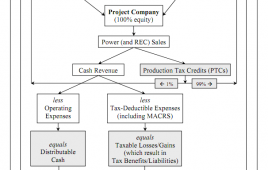
For example, a variation of one of the most common financing arrangements in the U.S. wind market, the special allocation partnership flip structure, was first developed by community wind projects in Minnesota more than a decade ago before being adopted by the broader wind market. More recently, a handful of community wind projects built over the past year have been financed via new and creative structures that push the envelope of wind project finance in the U.S. In many cases, they have moved beyond the now-standard partnership flip structures involving strategic tax equity investors. The report explains this past year has seen a wave of financial innovation in the community wind sector.

report

Schematic of strategic investor flip structure using the PTC. Forward slashes distinguish between pre- and post-flip allocations of distributable benefits. -Berkley National Lab

The partnership flip structure was first devised in response to the specific nature of federal policy support for wind power projects, specifically the inability of most individuals to make efficient use of the production tax credit (PTC) and accelerated depreciation. Likewise, so too has this new wave of financial innovation in the community wind sector been driven by policy changes, most of them recent. For example, as the report describes, for a limited time the American Recovery and Reinvestment Act of 2009 enables wind power (and other types of) projects to elect either the 30% investment tax credit (ITC) or a 30% cash grant in lieu of the PTC. This flexibility, in turn, enables wind power projects to pursue lease financing for the first time. Neither the ITC nor the cash grant is subject to the PTC’s requirement that the project owner also operate the project in order to be eligible for the incentive. The ITC and Section 1603 grant also reduce performance risk relative to the PTC, and (unlike the PTC) neither the ITC nor the grant is penalized for the use of subsidized energy financing. Finally, by providing a cash rather than tax incentive, the cash grant alone reduces, but does not eliminate, the need for tax appetite among project owners. All of these policy driven changes can be particularly useful to community wind projects.

Another policy-related enabler of some of the financial innovation profiled in the report include New Markets Tax Credits, which are not new but have only recently been tapped to help finance solar projects and, for the first time, in 2010 have been part of a community wind project financing. Also, Section 6108 of the 2008 Farm Bill expands the USDA’s authority to loan to renewable generation projects even if those projects are not serving traditional rural markets.

The collective experiences of the five community wind projects profiled in report can be distilled into the following common observations or lessons learned regarding the development and financing process. These include how the Recovery act was critical in the project, working with nearby projects can help ease the burden, partnering with experienced professionals pay of, take advantage of tax credits, and more highlighted in the report.

-www.lbl.gov

Small wind a big part of Solar and Wind Expo

August 3, 2010 by  
Filed under Small Wind Power, Wind Power News

solar wind 2010 7893 opt 300x300

Scott Merrick (with glasses) talks to an attendee at the Bergey Windpower booth at Wind and Solar Expo. The company’s XL.1, a 1kW battery-charger turbine sits to the right. He says the turbine will be available as a direct grid-tied version within a year.

Small wind was a highlight of the Solar and Wind Expo (www.thesolarandwindexpo.com) a consumer-oriented renewable energy event recently held in Baltimore. Several small-wind companies exhibiting were enthusiastic about the event and its attendees. “They came to see and learn about the latest in renewable energy equipment,” said Gary K. Sorrelle, a wind specialist with Atech Energy in Oxford, Pa. Atech displayed an Endurance S-250 residential sized wind turbine blade, a unit with an 18-ft dia. rotor.

“This was the most successful show we have participated in this year,” said Susan Fausnaught, operations specialist at Groundloop/A+ Solar, Darlington, Md. The company sells and services solar, wind, and geothermal equipment. “A significant numbers of attendees had researched different products and knew exactly what they were seeking.” A+ Solar showed a Swift turbine, manufactured by Cascade Engineering, Grand Rapids, Mich.

Also important, added Atech’s Sorrelle, is that the event is a great opportunity to introduce the Mid-Atlantic region to the benefits of ‘small wind’ turbines. It has been assumed the Mid-Atlantic region is unsuitable for wind turbines. But with ever-rising energy costs and advances in technology, wind is a viable option for the region. The next Solar and Wind Expo is slated for May 13 to 15 2011, at the Timonium Fairgrounds. WPE

Is it a chimney…or a turbine?

March 22, 2010 by  
Filed under Small Wind Power

SET twind on chimney 300x226

The SET is the work of U.K. inventor Rupert Sweet-Escott, whose would like to put “a SET on every house.” The turbines range in power from 50 to 250 watts and start around $1,132.00.

Wind turbines on houses are not always practical because some home owner associations would object to the noise it might make, or neighborhoods that restrict changes in aesthetics. A U.K. inventor may have solved the problem with a design called the Secret Energy Turbine (SET) because it disguises the turbine as part of a chimney. The small vertical axis turbine, painted the same color as the bricks in a chimney, make it appear to be a ordinary chimney stack. The unit is said to work in near silence because of its unusual design, which features vertically mounted blades fixed under the influence of two opposing magnets. The result is said to be an efficient turbine with only one moving part that tolerates winds over 90 mph.SET w dimensions 276x300

Small wind certification testing goes regional

March 22, 2010 by  
Filed under Small Wind Power

The DOE recently announced the selection of four partners to establish small wind Regional Test Centers (RTCs) to conduct tests on small wind turbines to meet national and international standards.  These awards provide funding, training, and technical support for each Regional Test Center so they may conduct testing on two small wind turbines to support the burgeoning U.S. small wind turbine market.

Award recipients are:

Intertek Testing Services NA Inc. in New York,

Kansas State University,

The Alternative Energy Institute at West Texas A&M University, and

Windward Engineering LLC in Utah.

One goal of the Regional Test Center project is to support the U.S. small wind market by increasing the number of organizations qualified to conduct small wind-turbine-standards testing and to drive down testing costs. Test results are used by certification bodies, such as the Small Wind Certification Council, to certify small wind turbines for durability and performance.

Certification testing lets small wind turbine buyers make informed choices and provides states with the data needed to determine turbine eligibility for incentive programs. These Regional Test Center awards are provided by DOE and NREL in a continuing effort to support the growth of the U.S. small-wind-turbine market and lets U.S. manufacturers sell their small wind turbine products abroad.

Analyzing building-integrated wind

February 18, 2010 by  
Filed under Small Wind Power

Wind Spire

A better understanding of wind flow through cities will give companies that manufacture and erect turbines, such as Mariah Power, Reno, Nevada, a better idea of where to place units for maximum power production.

Russell M. Tencer/CEO, Wind Products LLC/New York, NY

Controversy seems to follow the installation of wind turbines on building rooftops, and for good reason. On one hand, there can be considerable wind with harvestable kinetic energy at roof level. Accessing this clean, renewable source of power can be a good way for building owners to save money on their electric bills, reduce their dependency on the grid, and trim their carbon footprint. On the other hand, it has been difficult to understand how the wind behaves in built up areas, resulting in low power outputs and ultimately, bad reviews. Historically, many people have installed rooftop turbines on the assumption that even if the devices don’t work well, they’ll look good.

The challenges
As with traditional tower-mounted wind turbines, if a building-integrated wind turbine (BIWT) is to be successful, it must be assessed in terms of its net economic benefit. To date, BIWT installations have consistently missed power output expectations, as much as 90% in some cases. After careful review of BIWT installations on a global scale, it is clear that a main culprit behind these underperforming wind turbines is their placement. This conclusion is confirmed by a section of the American Wind Energy Association’s 2009 Small Wind Market Study calling for improved assessment technology.

Part of the problem is that urban and suburban areas include considerable turbulence and turbines mounted there have simply not been capturing enough laminar wind. Predicting wind-energy quality and density is more complicated in built up areas, such as cities, than in rural plains where there are few obstacles upwind of the turbine.

Traditional methods of assessing wind-energy density each have drawbacks, especially when applied to more complex areas. Anemometers must be set up on their own meteorological towers and collect data for at minimum 3 months, but really a year or more is required to be accurate. Wind maps are not built for site selection as much as screening, with even the tightest resolutions still overlooking local effects. Computational fluid dynamics studies show promise, but are still quite costly and difficult to set up properly. Existing technology leaves building owners and wind installers ill equipped to properly analyze the complex wind conditions, leading to poor site selection and inadequate power output. As a result, most BIWT’s are commissioned without a serious wind study to determine a best location, or in many cases, even if the site is appropriate at all. So it is not surprising that most building mounted turbines have failed to reach their expected power outputs. With such results, it is also not surprising that many have criticized the use of wind turbines on building rooftops.

BIWTs have yet to prove themselves to the small-wind community accustomed to installing turbines on tall towers in open terrain. However, BIWTs have one advantage over ground-mounted turbines typically positioned in good wind 40 meters up: BIWTs don’t need a costly 40-m tower to reach that height. On a sufficiently high building, typically one will never need more than a 10-m tower to clear turbulence caused by wind hitting the roof edge. Assuming equal installation costs, a 10-m tower on a 10 story building could cost $20,000 less than a 40-m tower reaching comparable heights. Despite this, for BIWTs to be taken seriously though, performance must improve, and for performance to improve, siting must improve.

The way forward

To understand wind in urban areas, it is necessary to consider many things ignored by existing evaluation tools. One must address the timing issues of anemometers, the accuracy issues of wind maps, and the cost issues of CFD studies. It is first important to consider the topography and texture of the area for several kilometers around the target site. This accounts for general turbulence in the local environment, a condition called roughness. Understanding this is required because even in cities like Atlanta or Los Angeles where there are relatively few tall buildings, the air is still quite rough due to the presence and extent of many smaller buildings.

PhelpsHIghSchool

Perhaps most important is the need to consider local effects, factoring for the size, shape, height, and distance of various obstructions. This incorporates the wind energy impacts of nearby trees, buildings, and other structures to understand how much the wind is blocked, what turbulence is created, and in some cases, how much the wind speed is increased. Further, if mounting on a building, it is critical to account for effects from the building, details such as its surface, roof edge, and roof features such as towers or chillers. For example, when wind hits any obstruction, it creates a separation zone arching out from the top of its vertical face. Above this point, the air remains smooth, but below, it becomes quite turbulent. This behavior must be considered in every rooftop-wind project to figure out how much higher the turbine must be mounted to capture energy from the smooth airflow.

So to improve the performance of building integrated wind turbines, one must consider local roughness, blocking, turbulence, and roof dynamics, something most assessment tools do not do. Furthermore, customers want answers quickly regarding wind energy potential at a reasonable price, another thing most tools have not done well.

Analysis services however, are available which meet these market needs – information on wind energy and expected performance can be delivered quickly for a small fraction of installed turbine cost. With better data, installers and customers can make better decisions, which will lead to better performance of building integrated wind turbines. This opens up the urban wind energy market for explosive growth in the coming years.

A few company initiatives are available at www.windanalytics.com.

Wind-turbine manufacturer adds solar interest, changes name

Earth turbines 2500 clearer 143x300

The Earth Turbine 2500 can generate 2.5 kW in a 11 m/s wind.

Earth Turbines Inc, Williston, Vermont, the state’s only manufacturer of small scale grid-connected wind and solar tracking systems, announces a corporate name change to AllEarth Renewables Inc. “Our company is dedicated to developing new wind and solar technologies,” says David Blittersdorf, CEO and president of AllEarth Renewables.  ”We want to be sure that our corporate name reflects this larger focus for the future.” Since founding Earth Turbines in 2005, Blittersdorf has lead a team of engineers dedicated to designing rugged and reliable grid-connected renewable energy systems that help homeowners and businesses realize the dream of generating electricity with local, renewable energy.  Much of what was learned while testing and refining the Earch Turbine 2500 influenced development of the AllSun Tracker dual-axis solar system, which was introduced in May of 2009.

The company provides turnkey site assessment, permitting, and installation for both the Earth Turbine 2500 and the AllSun Tracker dual-axis solar system. The company adds that with a 30% federal tax credit and available Vermont tax credits or rebates, each renewable energy system can fit the budget of a wide array of consumers seeking to reduce their dependence on nuclear and fossil fuels, support renewable energy and assure a fixed-cost, reliable power source for their home or business.

The Earth Turbine 2500 uses a patented direct drive, induction generator with no inverter or gearbox. The innovative design was chosen for its reliability and relative simplicity. The system is mounted on a 112-ft guyed tilt-up tower, placing the turbine at best height to capture wind. The company says the 2500 weighs a hefty 450 lb, providing unprecedented durability for a small wind system. The turbine uses a wireless monitoring interface and is easily installed and connected directly to the grid through homes or businesses. After a five-year testing period, sales of the Earth Turbine 2500 are scheduled to begin in the summer of 2010.

More than 80 AllSun Tracker solar systems have already been installed, including 36 at the Green Acres Tracker Farm in Hinesburg, Vermont, the largest solar installation to date in the state. The electricity produced by the Green Acres Tracker Farm (estimated at 200,000 kWh per year) is divided between the corporate headquarters of AllEarth Renewables and NRG Systems of Hinesburg through a process called group net-metering. This allows sharing the electric output of a system among multiple entities located within the same utility service area. The company estimates that with the electricity generated by the Green Acres Tracker Farm, both NRG and AllEarth Renewables will meet 100% of their electricity needs.

Tech specs for ET 2500

Cleanfield Energy adds Smart controls to turbines

A 3.5kW vertical-axis wind turbine is said to produce clean, reliable energy for residential and commercial applications. The system can mount on flat rooftops, as well as traditional towers and poles. The V3.5 from Cleanfield Energy, Ancaster, Ontario, Canada, can be installed without the need to change existing wiring, and can be used for both grid-tie and off-grid applications.

Clean field energy Article

3.5 KW turbine with smart technology

The design has three major components – turbine, generator and inverter – that are said to have features customized by the company. The firm says its modifications allow for maximum efficiency and reliability.

Cleanfield says the turbine has few moving parts to provide good reliability while the stationary center structure can accommodate grounding for lightning protection.

The turbine’s high aspect ratio accommodates its low nominal rotation speed. As a result, a low blade-speed ratio (ratio of blade speed to wind speed) minimizes audible noise. The blades connect to the shaft with two struts for a low-loss aerodynamic profile, which contributes to a better power coefficient.

The turbine comes with a custom-developed sensor and interface board which communicates with the inverter for data collection, supervision, and protection of the hardware. This feature extends the unit’s life expectancy and lowers maintenance costs. The sensor board monitors turbine vibration for resonant frequency skipping and to shutdown the turbine should sensors detect excessive vibration. Thermal sensors monitor generator temperature so controls can reduce its output power and eventually shut it down when it approaches the thermal operating limits. The unit will not start if the outside temperature drops below -40C. This prevents bearing damage. An electromechanical brake ensures a controlled stop and limits the turbine speed to ensure it operates within safety limits and max efficiency.

The direct-drive generator works at low speed because of its permanent magnet design. The external rotor matches turbine parameters, such as nominal rotational speed, nominal torque, and assembly requirements. The generator is built into the system structure.

A fail-safe electro-mechanical brake with status feedback must be energized for release and so engages in a power loss. Shutting down the power stops the turbine from spinning and also lets service and maintenance work proceed safely.

The inverter uses a custom algorithm to control the generator. The flux-vector-control software provides a way to monitor voltage, frequency, and current without costly and unreliable external sensors. The software can also profile and predict patterns and conditions.

The rotor is controlled by regulating current to and from the generator. The control algorithm allows variable-speed operation so the generator delivers optimum power while staying within safety limits. As a result, even in gusty or high winds, the turbine speed will not exceed 160 rpm. The table includes a few more particulars.Clean field energy Table

Vertical axis turbine works well atop office building
Quietrevolution windtunnel 150x150

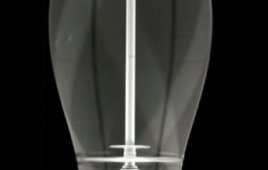
The S-shaped blades are tapered to shed noise. The helical design captures turbulent winds and eliminates vibration. The blades, spars, and torque tube are made of durable carbon fiber and all moving parts are sealed to minimize maintenance. The direct drive inline generator has built in auto shutdown and peak power tracking.

One forecast for small scale wind generators (sometimes called microgeneration) has them providing 30 to 40% of all the UK’s electricity needs by 2050. The British Wind Energy Association hints that with price trends for crude oil continuing up, the cost of small scale wind could be competitive with fossil fuels by as early as 2010.
Although the UK has excellent wind resources, where the turbine is located is still crucial to the output expected from it. Ideally, a wind turbine would have no obstructions between it and the prevailing wind direction.
In an urban or built-up environment, some wind turbulence is inevitable unless the turbine is sited well above any surrounding buildings. Most of the time, turbulence from surrounding buildings will affect a wind turbine to some extent. This is the primary reason for opting for a vertical-axis wind turbine, because the design doesn’t require wind from a consistent direction to produce power. A horizontal axis wind turbine, on the other hand, has to physically rotate into the wind every time the direction changes.
U.K.-based quietrevolution says its 5-kW helical design ensures good performance even in turbulent winds. It is also responsible for almost eliminating noise and vibration. At five meters high and three meters diameter, it is compact and easy to integrate. And with just one moving part, maintenance can be limited to an annual inspection. The table includes a few specs:

A home turbine for net metering

July 13, 2009 by  
Filed under Small Wind Power

Skystream 3.7 210x299

The Skystream 3.7 can generate for a typical home in California (where energy costs $0.14/kWh) about 400 kWh/mo that would save about $672/year.

A wind generator for grid-connected homes is said to let users take control of their energy bills. The Skystream 3.7 from Southwest Windpower, Flagstaff, Ariz, lets those in certain states can take advantage of ‘net-metering,’ or the sale of unused energy back to the power grid.

The turbine is said to be the first residential wind appliance to produce energy at a cost of $.09/kWh, a rate lower than that of many electric utilities. The turbine cost is about $5,100. Depending on the tower and installation costs, wind-speed average, rebates and local electricity costs, developers say the turbine can pays for itself in four years. The turbine provides an all-in-one package with built-in controls and inverter for harnessing wind energy on a residential scale.

Intended for low winds, the unit begins producing power in an 8 mph breeze with full output at 20 mph. The turbine mounts on a 35-ft. tower, so households on lots of one acre or more will now have access to residential, grid-connected wind energy. Towers up to 110 ft. are available. A site assessment is important to determine a best tower height. The turbine operates quietly and is often unrecognizable over trees blowing in the wind.

For a typical home in California (where energy costs $0.14/kWh) the turbine will produce about 400 kWh/mo. This will save the household $672/yr on their utility bill. At this rate, they will pay for the unit in about 12 years. Payback can be as low as seven years with rebates, assuming an $8,500 installed cost. The table lists a few particulars.

HPM America launches 1kW to 1 MW wind turbines

July 1, 2009 by  
Filed under Turbine Design, Wind Watch

HPM turbine 300x200

Wind turbines from HPM America will be available from a small 1kW unit to 1MW versions. Modern wind-power generators are an excellent source of electricity for those looking for a cost effective and environmentally friendly power source.

Wind-generated electricity in some locations is close to the cost of power from conventional utility generation. Wind power, the world’s fastest-growing energy source, will provide industry, businesses, and homes with clean, renewable electricity for many years. So in keeping with this year’s theme at NPE (National Plastics Exhibition) 2009 in Chicago of “Energy Efficiency and Renewable Energy” along with “Going Green” HPM America unveiled its newest product line – WIND TURBINES.

Introducing this line of turbines lets HPM America, Mount Gilead, Ohio, address the needs of home owners, businesses, schools and universities, governmental institutions and other applications. The new turbines will be available from small 1kW units to 1MW versions. People throughout the world are advocating for wind turbines and their positive effects on the environment. HPM America says it is devoted to helping people purchase and attain wind power electricity sources.

HPM says its turbines will use Axial Flux Permanent Magnets (AFPM) which generate power more efficiently and at lower wind speeds due to its coreless technology. The generators eliminate traditional cogging issues, making them ideal for wind turbines.

In addition, the generator design eliminates need for a gearbox as part of the unit’s drive train, thereby minimizing down time and reducing maintenance costs over the life of the system.

In AFPM generators, a coil wraps around a specially designed disc at the center axis. Magnetic discs then rotate on the sides of the coiled disc and generate electricity. This kind of power generating technology is ideal for generating power from the wind because its initial operation torque (cut-in speed) is lower than the often used Radial Flux Permanent Magnet (RFPM) method.

AFPM power generation is classified into two configurations, the inner type and outer type. In the inner type configuration, only the magnetic disk rotates while the generator housing remains fixed. In the outer type configuration, the whole generator body rotates by fixing the magnetic disk to the body. Both configurations can be provided depending on the application specifications.

When the generator is producing electricity, it also produces heat, and as heat increases, generator efficiencies decrease. To solve this problem, HPM generators are liquid cooled. This significantly reduces associated wear that high-temperatures can cause, and thus improves the generator’s life-span. What’s more, the company says the price point on its systems ensures a faster return on investment to the end user.

HPM America manufactures and supplies extrusion systems, injection molding machines and die casting equipment along with providing contract manufacturing from its headquarters in Mount Gilead, Ohio, U.S.A. HPM America maintains offices in Sao Paulo, Brazil and Chennai, India along with a network of manufacturer representatives and consultants that cover Mexico/Latin America, China and the Pacific Rim, and Europe. In the U.S. and Canada, HPM works directly with customers.