China to build and warranty turbines for Greece

Sinovel sl5000 300x199

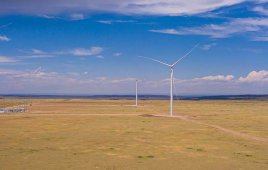
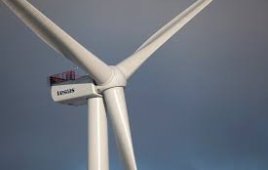
SL5000 series of wind turbines from Sinovel, one possibility for the Greek order, come with variable pitch and speed, and double-fed generators.

Sinovel Wind Energy Group Co. recently visited Greece to sign a wind-energy contract with Public Power Corp SA, according to an executive at the utility.

Four representatives of Sinovel, including Chairman and President Han Junliang, attended the meeting in early September with Ioannis Tsipouridis, CEO of Athens-based PPC Renewables SA.

The 200 to 300-MW onshore wind project is planned for Rodopi in northern Greece. Under the agreement, Sinovel may be an equity partner in this and other projects. The partnership may also let PPC Renewables win financing from the China Development Bank Corp.

“I would like Sinovel to be co-investors and hope our cooperation involves some financing,” said Tsipouridis. The bank may fulfill the role of an export credit agency and guarantee a Sinovel loan.

Chinese turbine makers are expanding abroad as nations from the U.S. to Europe add wind farms to curb emissions and cut reliance on fossil fuels. By one account, four of the 10 biggest global suppliers were Chinese in 2010. Public Power and Sinovel agreed earlier in the year to team up for on an onshore wind park in Greece and possibly an offshore park and turbine plant.

Greece is struggling to cut the biggest debt burden in the euro region’s history while seeking to meet the Europe’s clean-energy target by 2020. The nation hopes to have installed 10,000 MW of wind power by then, up from the current 1,300 MW, according to Tsipouridis. That could be 8,700 MW more, or 4,350, 2-MW turbines, a large order by any standard.

Last year, Vestas Wind Systems said it expects growth in Greece as the government moves to attract renewable-energy investment. Tsipouridis suggested that the country can be a “gate” for Chinese turbine makers to enter the European market.

Sinovel
www.sinovel.com

Turbine Doctors Revive a ‘Dead’ Vestas

It took two engineers from Availon North America a matter of hours to repair and bring on-line a Vestas V27 225-kW wind turbine that belongs to the Story County Medical Center in Nevada, Iowa. The turbine was commissioned at the end of 1994 but stopped working in April 2011 when the power supply for the PLC controller died. The part, one called “inactive”, is still available but difficult to find and expensive. Replacing the failed part with a not-yet-found version was the only solution offered by the service provider. Due to the high cost and the long lead time, the clinic decided to just leave the turbine unrepaired until another solution could be found.

Andrew Engle

Andrew Engle, mechanic product support engineer for Availon, checks a couple more items in the nacelle of the once ailing Vestas V27 that is sited on the grounds of the Story Country Medical Center. Assisting in the project but not shown is Weston Smith, an Electrical Product Support Engineer.

So the turbine sat idle until its project coordinator, Jim Miller, learned of Availon North America’s experience servicing wind turbines. Within 24 hours of agreeing to service the turbine, Availon technicians had the unit back on-line. How did they do it? Availon says their engineers, who frequently service Vestas turbines, recognized that the company’s more recent V80 uses a similar power supply with just a few more features. The crew installed the readily available supply and gave permission for the turbine to return to productive work.

WPE

A cure for radar ills?

September 5, 2011 by  
Filed under Construction, Wind Power News, Wind Safety

Radar Vestas

Lockheed Martin plans to send its TPS-77 radar system to British coastlines where five offshore wind projects have enlisted the technology to detect potential air attacks.

Radar has difficulty distinguishing between airplanes, wind turbines, and stormy weather. Spinning blades reflect radar signals and create sensory interference and coverage shadows—a troublesome effect for air traffic controllers and military surveillance. Vestas, however, says recent developments will alleviate some worries and allow placing wind farms nearer to airports and military bases. The Danish company says it successfully tested a “stealth” rotor for its V90 model.

A Federal Aviation Administration permit for Oregon’s Shepherds Flat was delayed last summer when the Pentagon objected to its proximity to an Air Force base. Vestas estimates the radar issue is blocking plans for about 20 GW of wind power capacity worldwide.

Vestas says the rotor, made of radar absorbing materials, showed a 99% reduction in reflected radar waves compared with standard turbines. For five years, the company and British defense contractor QinetiQ have been collaborating on turbine components that can dip under the radar. In 2009, they designed stealth turbine blades. Coatings of radar absorbing materials can work with turbine towers. However, the extra weight of a 5-mm coating on long, thin blades would hurt the performance. The recent blades’ structure features sheets of glass-reinforced epoxy and plastic foam. Costs were undisclosed although the company says it wouldn’t be significant. When they would be available is also unknown.

Another approach to modernizing radar is the UK’s National Air Traffic Service is looking into adjusting its Raytheon systems software with new algorithms. The upgrades may be able to discriminate between a turbine and say an aircraft flying over.

Vestas
vestas.com

Survey shows 90% globally favor renewable energy

August 30, 2011 by  
Filed under Business issues, Policy, Wind Power News

TNS Gallup survey for Vestas 284x300

The chart come from the Vestas sponsored survey.

Consumers around the world overwhelmingly support the rollout of renewable energy, but many have mistaken views about “green” products, according to a survey conducted by TNS Gallup for Vestas Wind Systems. The May 2011 survey polled 31,000 consumers in 26 countries and was intended to show companies how they could link their image to customers’ views on renewable energy. But the poll also showed that many consumers were ill-informed about companies’ environmental impacts, as well as the availability of renewable power.

“Vehicles powered by fossil fuel account for a significant part of global emissions, yet automobile manufacturers … have acted to persuade consumer opinion, for instance with advertising claims about the energy efficiency of gasoline or diesel powered vehicles,” Vestas said in statement about the survey.

The poll showed 79% of consumers surveyed would view as “positive” the companies that primarily use wind energy, with only 4% viewing that as “negative.”

A strong 90% of global consumers backed an increase in renewable energy, while 15% said nuclear power sources should increase, and 8% said use of fossil fuels use should rise.

Consumers in China were strongly in favor of increasing renewable energy sources, with 95% of those surveyed supporting it, well above the 77% in the United States who favored it. But 72% of Chinese consumers also believed they had access to green electricity — a figure far higher than reality. Coal remains the largest source of Chinese power generation, according to International Energy Agency, even though the wind industry there is growing rapidly.

Half the consumers surveyed said they would be willing to pay higher prices for products made using renewable energy, while 45% said they would not pay more. Developing nations’ consumers were most willing to pay extra for products produced using renewable energy, with 72% of those in China, Chile, and India saying they would spend more.

TNS Gallup
www.tnsglobal.com

Bummer: China slows PM materials so OEMs looking elsewhere

July 23, 2011 by  
Filed under Materials, Policy, Wind Power News

7 VY sea 212x300

Vestas is developing a 7-MW machine that it says will use neodymium in a generator driven by a gearbox.

Here’s a fly in the direct-drive ointment. China has been the world’s largest supplier of rare-earth materials, those used in high flux permanent magnets needed for direct-drive generators. The nation recently curbed production of the materials, most likely for its own use. China had supplied more than 90% of global rare earths, a group of 17 elements used in electronic technologies from electric motors to sonar systems. The country imposed controls on mining and exports after more than a decade of extraction depleted the resources and harmed its environment.

Turbine OEM Siemens, however, would like to develop supplies for rare earths in Australia, Russia, Greenland, and California to limit price increases and keep materials flowing to their products. Siemens Wind CTO Henrik Stiesdal says his company is developing a variant that uses no rare earth magnets at all. Siemens recently installed a 6-MW prototype direct-drive machine. According to Stiesdal, the company will offer geared turbines through 2015 as it transitions its products to all direct-drive technology.

In contrast, Vestas makes geared wind turbines with generators that the require only 10% of the material used in other direct-drive machines. So the generators do not depend heavily on the rare earths from China, according to the head of Vestas R&D Finn Stroem Madsen. “We will not deliver a technology that depends on a strategic raw material, such as the rare earths,” he says.


Vestas
www.vestas.com

Offshore turbine designed for rough seas

April 28, 2011 by  
Filed under Turbine Design

VY bus 467 300x147

The V 146 boasts 7.0 MW and a rotor diameter of 164 m.

Lowering the cost of energy in relation to offshore wind is essential for the industry. Some of the major stepping stones in achieving this are size and subsequent increased energy capture, which means a need for much bigger turbines that are specifically designed for the challenging offshore environment. Companies are taking steps in improving offshore models. For example, Vestas has introduced its V164-7.0 MW off shore turbine.

The turbine has a wide range of technical features and is larger in size for increased energy capture with a medium-speed drivetrain. “We actually kept all options open from the start, running two separate parallel R&D development tracks,” says Finn Strøm Madsen, president of Vestas R&D. “One focuses on direct drive and one on a geared solution. It soon became clear that if we wanted to reach lowest possible cost of energy and high business case certainty we needed a combination of innovation and proven technology, so the choice could only be to go for a medium-speed drivetrain.”

According to Anders Søe-Jensen, president of Vestas offshore, the offshore wind market is set to really take off over the coming years, but more so in some parts of the world than in others. “We expect the major part of offshore wind development to happen in the Northern part of Europe, where the conditions at sea are particularly rough,” he says. “Based on our offshore experience we have designed the 7.0-MW model to provide the highest energy capture and reliability in this rough and challenging environment. This makes our new turbine a good choice for many projects, such as UK Round 3 building.”

Based on the potential market size, the company will target Europe and primarily the Northern European markets with its new turbine. However, should market demand require so, Vestas is also prepared to take the turbine to other parts of the world. Construction of the first V164-7.0 MW prototypes is expected in Q4 2012. Serial production is set to begin in Q1 2015 provided a firm order backlog is in place to justify the substantial investment needed to pave the way for the V164-7.0 MW.

Vestas


Ohio’s first large wind farm becomes three

Wynford Vestas V90 466x468 298x300

Turbines like these from Vestas are sprouting up on wind farms in the western countryside of Ohio.

Construction workers, about 200 by one count, are working on the 99 MW wind farm Timber Road II. And just south of that in Ohio’s southwestern Paulding County sits Van Wert county where more wind turbines are beginning to pop up. Horizon Wind Energy is at work there on an initial stage. The original plan for Timber Road II has been divided into two projects. The portion under construction will consist of 55, 1.8-MW Vestas’ with 95-m rotors for a max possible output of 99 MW. Turbines to produce the remaining 50 MW are part of what is now being called Timber Road III.
“Construction on Timber Road II began December 2010 and will complete with operation start by mid-summer,” says Project Manager Erin Bowser. “A few turbines are up, and the guys are starting to hit their stride, so weather permitting, one or two more will finish every day.”
Timber Road I will come later in Paulding County’s Harrison Township. There, 30 turbines will generate up to 48.6 MW. Still in planning stages is Timber Road IV which will take in eastern Harrison Township, work south through Paulding and Blue Creek Township and across into Tully Township of Van Wert County. Another developer in the county, Iberdrola Renewables’, is working on the Blue Creek Wind Farm, which will put up 152 turbines to generate a peak of 304 MW.
If all goes as planned, Horizon Wind Energy will install about 200 turbines among the four phases of Timber Road Wind Farm. That makes 350 turbines between the two projects. Developer BP Wind Energy is exploring the possibility of a wind farm in southern Van Wert County.

The county has also hired an operations manager who will run the wind farm upon its completion. In addition, the Timber Road Wind Farm will also have technicians on site as well as personnel from Vestas.
Horizon Wind Energy
horizonwind.com

Teaming up for safety training

January 19, 2011 by  
Filed under Maintenance, Wind Safety

vest

The outcome of the testing is now being incorporated in the course material and the Basic Safety Training Program is expected to launch in the first half of 2011.

Wind turbine manufacturer Vestas is teaming up with competitors and costumers to create a standard for basic safety training. This is done in the framework of the Global Wind Organization (GWO), which Vestas started up in November 2009 together with competitors like Siemens and Suzlon and with several key accounts including SSE Renewables, Vattenfall, and RWE Innogy.

“The renewables industry is progressing fast and, with offshore wind in particular, we enter a new and challenging business,” says Thomas Schuchart, safety engineer at RWE Innogy and member of the GWO Steering Committee. “Now is the right time for joint approaches like this and we expect that it will be highly beneficial to all of us within the industry.”

Today, customers must support the cost of training technicians in multiple different safety courses if they own turbines made by different manufacturers, the organization explains. In the future they only have to participate in one course if their manufacturers are members of the GWO. The same goes for subcontractors.

While safety is already a priority, Vestas benefits from the new standards. “The course content is quite similar to what Vestas already has in place, but it will be more comprehensive,” says Safety Specialist Lars Odby, also a member of the GWO Steering Committee. ”Today, in some areas of Vestas, documentation, when it comes to the skills of our external course providers, is not good enough. With the new standard, we set clear expectations to the providers.”

The Basic Safety Training Program is now finalized, and a test trial of the different modules has just been conducted. “We are aiming to make the best basic training, incorporating already known standards,” says Philip Hill, HSE & Education coordinator in Vestas Offshore. ”We are getting a lot of great, constructive feedback, and it has just been a major team effort.”

Vestas www.vestas.com

Vestas on a roll – 50 MW more for Nuevo Mexico

Vestas V100 244x300

The V100-1.8 MW turbine is said to work well in low and medium-wind speeds and for many years.

Vestas has received a 50.4 MW order for 28 V100-1.8 MW wind turbines from Element Power for the first phase of the 99 MW Macho Springs Wind Energy Project in Luna County, New Mexico. The contract includes delivery and commissioning along with a 10-year turbine service and maintenance agreement. Delivery is scheduled for early 2011 and commissioning is expected in mid-2011.

The V100-1.8 MW turbine is said to work well in low and medium-wind speeds and for many years. Element Power has an option to purchase an additional 27 V100-1.8 MW wind turbines for the second phase of the project, which is targeted to proceed as early as next year. The order marks Vestas’ 14th North American deal announced in 2010, totaling 1,784 MW among four turbine types. Five Vestas customers have ordered V100-1.8 MW turbines in the last six months for projects in the United States and Canada. Element Power develops, acquires, builds, and operates utility-scale solar and wind power projects globally.

Vestas

Vestas has received a 50.4 MW order for 28 V100-1.8 MW wind turbines from Element Power for the first phase of the 99 MW Macho Springs Wind Energy Project in Luna County, New Mexico. The contract includes delivery and commissioning along with a 10-year turbine service and maintenance agreement. Delivery is scheduled for early 2011 and commissioning is expected in mid-2011.

The V100-1.8 MW turbine is said to work well in low and medium-wind speeds and for many years. Element Power has an option to purchase an additional 27 V100-1.8 MW wind turbines for the second phase of the project, which is targeted to proceed as early as next year. The order marks Vestas’ 14th North American deal announced in 2010, totaling 1,784 MW among four turbine types. Five Vestas customers have ordered V100-1.8 MW turbines in the last six months for projects in the United States and Canada. Element Power develops, acquires, builds, and operates utility-scale solar and wind power projects globally.

Vestas

www.vestas.com

32 for Horse Butte

The Horse Butte Wind project near Idaho Falls, Idaho will feature 32 turbines and provide clean energy primarily to communities in Utah, as well as in Idaho, Nevada, Wyoming, and California.

Vestas will provide the V100,1.8-MW turbines for a 57.6-MW order. The contract includes delivery and commissioning along with up to a six-year service and maintenance agreement. Delivery is scheduled to begin in 2010 and commissioning is expected in the second half of 2011. Turbine may also be added later to bring the total project size to 99 MW. Utah Associated Municipal Power Systems (UAMPS), a political subdivision of Utah, will develop the project and purchase all of the energy from it for its participating members.

vestas

The project will consists of 32 Vestas V100-1.8 MW turbines.

“We are very excited to sell our first V100-1.8 MW turbine in the United States,” says Martha Wyrsch, President of Vestas Americas. “We also are supplying turbines for the first time to Idaho, which has strong wind resources and has great potential to be a high-growth state for wind power.”

“This is an exciting day for UAMPS,” says Doug Hunter, UAMPS’ general manager. “Our members take their responsibility of planning for the long-term energy needs of their cities and towns very seriously. Adding an additional wind resource to our power supply portfolio is a smart choice that gives our members more options, so they can continue to provide the cleanest, most reliable and affordable electricity possible to their communities.”

Vestas www.vestas.com

Page 1 of 3123