
Andrew R. Pfeifer, Metal Coatings International Inc., Chardon, Ohio, metal-coatings.com
Since the 1970s, users of high strength ASTM A490 bolts were prohibited from using metallic coatings. The main reason for this restriction was the possibility of early fracture due to hydrogen embrittlement. Following research presented to ASTM Committee F16 on Fasteners and the Research Council on Structural Connections (RCSC), the metallic coating DACROMET was added to the A490 specification as the only approved coating (2008) and is scheduled to be inlcuded in the next publication of the RCSC spec (2010).

A490 test bolts (left) were mechanically galvanized, hot-dip galvanized (middle), and coated with Dacromet. All were exposed to 5,000 hours of slat spray per ASTM B117. Each batch was identified with a different colored tape but corrosion covered it on all but the Dacromet coated bolts.
The coating, manufactured by Metal Coatings International, was evaluated according to the test method prescribed in the IFI-144 standard, “Industrial Fasteners Institute – Test Evaluation Procedures for Coating Qualification Intended for Use on High-Strength Structural Bolts”. The objective of the investigation was to verify that the structural integrity of high-strength structural fasteners was not compromised with the use of a metallic coating.
Extensive testing was conducted on two separate lots of 1-in. diameter ASTM A490 bolts supplied by two manufacturers. The test bolts were coated with DACROMET by an industrial facility under normal operating conditions (cleaning by alkaline wash, mechanical blast only, no acid pickling or electrolysis), while samples of uncoated bolts from each lot were retained for baseline results.
Results confirmed that the coating does not cause internal hydrogen embrittlement nor does it promote environmental hydrogen embrittlement (evidenced by the fact that there was no loss in the strength of the coated bolts following installation and exposure to corrosion testing). These are the most significant findings of the investigation because they address the primary concern that led to the prohibition of metallic coatings in the first place.
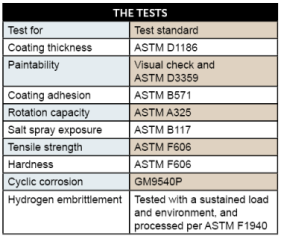
Other notable results from this study include:
Corrosion protection – Continuous salt spray and cyclic corrosion testing showed the superior protection offered by the coating, especially when compared to hot dip and mechanical galvanizing.
Thickness – The coating (~ 9 microns) was significantly thinner than the galvanizing methods.
Assembly – The coated hardware assembled according to industry requirements without use of a supplemental wax or lubricant.
This study correlates to the wind market on several levels. For instance:
• A490 bolts (or equivalents) are used throughout most turbine structures. Part manufacturers were previously restricted from supplying these bolts with a coating, but this research provides them confidence in supplying the approved finish.
• Studs used in towers, nacelles, and blades use materials similar to the A490 bolts, presenting a potential for embrittlement. To meet durability requirements in the most stable manner, the approved coating (or the chrome-free alternative GEOMET) should be used to protect these studs.
• Turbines located on the coastline or in off-shore applications will be exposed to highly corrosive elements. Conventional finishes may not provide the degree of protection required for various components.
Structural-bolting industries have embraced coatings on fasteners and hardware to protect their structures. For the wind industry, the approved coating should be well received because it will help it meet life expectancy of the growing off-shore wind farms, which are likely to receive maintenance visits less frequently than similar land-based facilities. As the wind industry continues refining its performance requirements, thin-film corrosion protective coatings will find wider use, thereby extending the life of its structures and ensuring this green technology endures.
Filed Under: Uncategorized




The ASTM A490 bolts are prohibited for almost a half century? It’s a very long time! Fortunately, the new result confirmed it has zero effect. The good news must be an early step to mass-produce it and hopefully it can compete with other similar products.