This article comes from ABB and is authored by Pat Hayes and Janissa Arevalo.
Many countries are currently in the early stages of a renewable energy revolution. However, as solar and wind-based generation capacities in electrical power networks soar, operators are finding it increasingly difficult to maintain grid stability and reliability.
 Two of the principal reasons for this are the short-term variability and low predictability inherent to renewable sources. Energy storage systems can address these issues and thus provide an important contribution to the evolution of the electrical power grid. However, energy storage can do even more than that: Placing energy storage strategically across utility fleets can also offer new ways to enhance the provision and pricing of electrical energy and associated services and provide a way to optimize the entire power system.
Electric energy storage encompasses a broad range of technologies: batteries, flywheels, pumped storage, heat storage and compressed air. Even electric vehicles can be used to store energy. At present, most utilities favor battery energy storage systems (BESSs) because these are easily scalable and can be located almost anywhere.
Regardless of which technology is being used, a complete energy storage system (ESS) – ie, one that can operate in standalone mode or be connected to the grid – has four major components: the storage medium, a control system, a power conversion system, and the balance of plant (BOP). The design of these components strongly depends on the energy storage application and the power rating required. The storage medium can be based on one of many battery technologies – eg, lithium ion, sodium-sulfur, nickel-cadmium, lead acid, or flow batteries.
 For higher power requirements, several power converter systems can be connected in parallel to provide dynamic control of active and reactive power flow in both directions. Furthermore, monitoring and control systems that allow manual and automatic operation of all components supplement the energy storage system. Communication protocols support remote control and monitoring and may provide load and weather forecasts. In addition to the system components, BOP equipment such as transformers, protection equipment, and switchgear are needed to ensure a safe and reliable grid connection and operation of the system.
Applications and benefits of energy storage
The benefits of energy storage span power generation, transmission, and distribution – ie, from the generator all the way to the end user. Further, modern storage technology and power electronics can support the operation of large, interconnected infrastructure – as well as small, isolated power system setups – across a wide range of applications
Frequency regulation
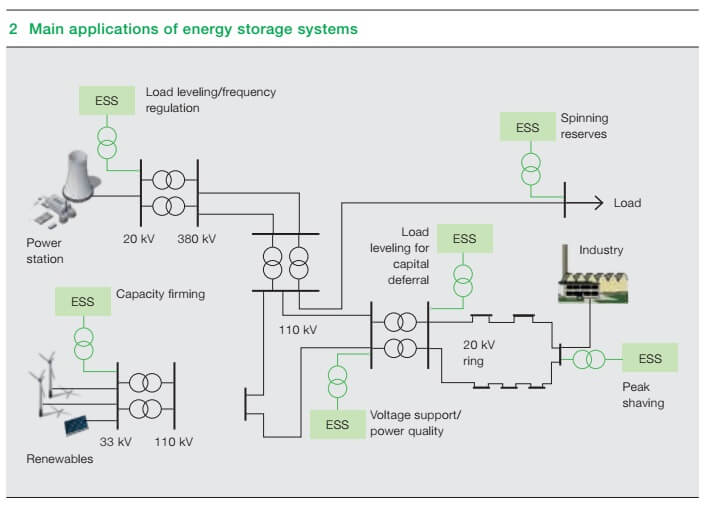
Using energy storage to provide ancillary services such as frequency regulation or to act as spinning reserves for the electrical grid is proving to be a successful business model that has minimal operation and maintenance costs – with a significantly lower carbon footprint than conventional generation. For frequency regulation applications, the ESS is charged or discharged in response to an increase or decrease, respectively, in grid frequency caused by a sudden misalignment of energy supply and demand. This approach is particularly attractive due to its rapid response time and emission free operation.
Spinning reserve
To provide an effective spinning reserve, the ESS is maintained at a level of charge ready to respond to a generation or transmission outage. The system can respond within milliseconds to supply power to maintain network continuity while the backup generator is started and brought online. This lets generators work at optimum power output, without the need to keep idle capacity for spinning reserves.
Load leveling
Load leveling usually involves storing power during periods of light loading on the system and delivering it during periods of high demand. During the periods of high demand, the ESS supplies power, reducing the load on less economical peak generating facilities. Because utilities must design their network to the peak power usage capacity, having energy storage strategically located next to the load allows for the postponement of investments in grid upgrades or new generating capacity.
Peak shaving
Peak shaving is similar to load leveling but is for reducing peak demand rather than for economy of power system operation. Peak shaving installations are often owned by the electricity consumer rather than by the utility. Commercial and industrial customers benefit from optimized time-of-use energy cost and demand charge management. Power quality For power quality applications, an ESS may help to protect downstream loads against short-duration events that affect the quality of the power delivered. For instance, voltage fluctuations.
For the rest of the 8-page article: https://goo.gl/j5d2M4
Filed Under: Energy storage