Governments, investors and businesses must seize the opportunity to halve global carbon emissions by 2040 while ensuring economic development and energy access for all, but they must act now to accelerate clean electrification, says the Energy Transitions Commission (ETC).
The ETC recently launched its “Better energy, Greater prosperity” report which argues that it is technically and economically feasible to grow economies and provide affordable, reliable, clean energy for all.
Key conclusions of the report include: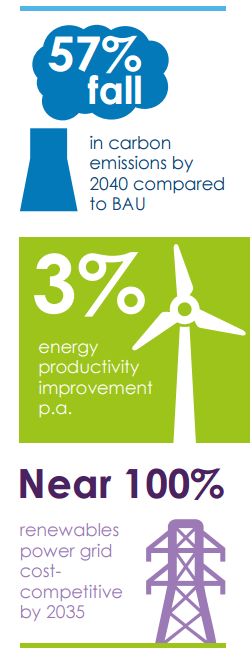
- Falling costs of renewables and batteries make cost-effective, clean electricity unstoppable and essential to the transition to a low-carbon, energy-abundant world.
- There is still untapped potential to improve energy productivity – i.e. the energy-intensity of GDP. Growth of 3% per annum could be achieved with the right policies effectively implemented.
- Rapid progress is now required on other technologies, including bioenergy, hydrogen and all forms of carbon capture and sequestration, to drive complete decarbonization. But even with large-scale CCS deployment, which is not on track, fossil fuels use must fall 30% by 2040, with a rapid decline of unabated coal.
“We are ambitious but realistic. Despite the scale of the challenges facing us, we firmly believe the required transition is technically and economically achievable if immediate action is taken,” says Adair Turner, Chair of the ETC.
To put the world on a well below 2C˚ pathway, we must decarbonize power generation and extend electrification to a wider set of activities in the transport and buildings sectors. Clean electrification alone could deliver half of the carbon emissions reductions required to reach 20 gigatonnes (Gt or 109 tons)of emissions by 2040.
But we must also decarbonize all the activities which cannot be cost-effectively electrified – such as aviation, shipping, and heavy industries like steel, cement or chemicals – and achieve a revolution in energy productivity. On both of these dimensions, progress is far too slow. To accelerate improvement requires stronger public policies and large-scale public and private investment, urges the ETC.
The transition to low-carbon energy systems would deliver important social benefits – with for instance dramatically improved air quality leading to longer and healthier lives – and economic opportunities related to the development of technologies and innovative business models, says the report.
“This is not just another plan; it’s a better plan. We show how the world can remove barriers to transform challenges into opportunities, not only in advanced economies but also in emerging countries,” says Ajay Mathur, co-Chair of the ETC.
The report reflects a unique collaboration between the diverse members of the ETC, which brings together fossil fuels, power, and industrial companies, alongside investors, environmental NGOs and researchers, from both developing and developed countries. These diverse allies are agreed not only on the importance of cutting global carbon emissions to meet the Paris objectives but also on how that transition can be achieved while fostering social and economic progress.
Pathways to low-carbon energy systems
The report describes how to cut annual carbon emissions from 36 Gt today to 20 Gt by 2040 (compared to 47 Gt expected by 2040 in a business as usual scenario), and set the stage for the further emissions reductions that will be required in the second half of the century, while ensuring universal access to 80 to 100 GJ of affordable, reliable and sustainable energy per capita per annum. This can be achieved through four interdependent pathways, says the ETC.
Clean electrification – By 2040, half of emissions reductions compared to a business as usual scenario could come from the combination of the decarbonization of power generation and the electrification of a wider set of activities in the transport and buildings sectors. Provided appropriate policies are put in place, it will be possible within 15 years to build power systems that rely on variable renewables for 80 to 90% of power supply and that can deliver electricity at an all-in cost (including back-up and flexibility needs) of less than $70/MWh, which is likely to be competitive with fossil fuels based power generation. This reflects the dramatic reductions in the cost of renewables and batteries now being achieved and most likely to continue. Clean electricity should then be used in an increasing range of economic activities, with growing potential to substitute clean electricity for fossil fuels in light vehicle transport and heating.
For the full report, visit the ETC website.
Filed Under: News