Editor’s note: I (Paul Dvorak) used the term low-level jetstream in a tweet to describe phenomena detected in a picture from a scanning lidar. I should have pointed out the low-level jet. My thanks to Christian Wetzel for catching the error.
You used the term “low level jet stream” which sounds like a combination of “low level jet” and “jet stream”. Both are completely different meteorological phenomena. “Jet stream” is frequently used in weather forecasting, especially in Northern America. The jet stream is the flow pattern in the upper atmospheric levels at about 500 hPa or 5 kilometer and higher. The shape and strength of the jet stream is an indicator for formation and movement of mesoscale weather system (cyclones). That means “jet stream” is not a very relevant term for wind energy topics and I think some readers might get a wrong impression.
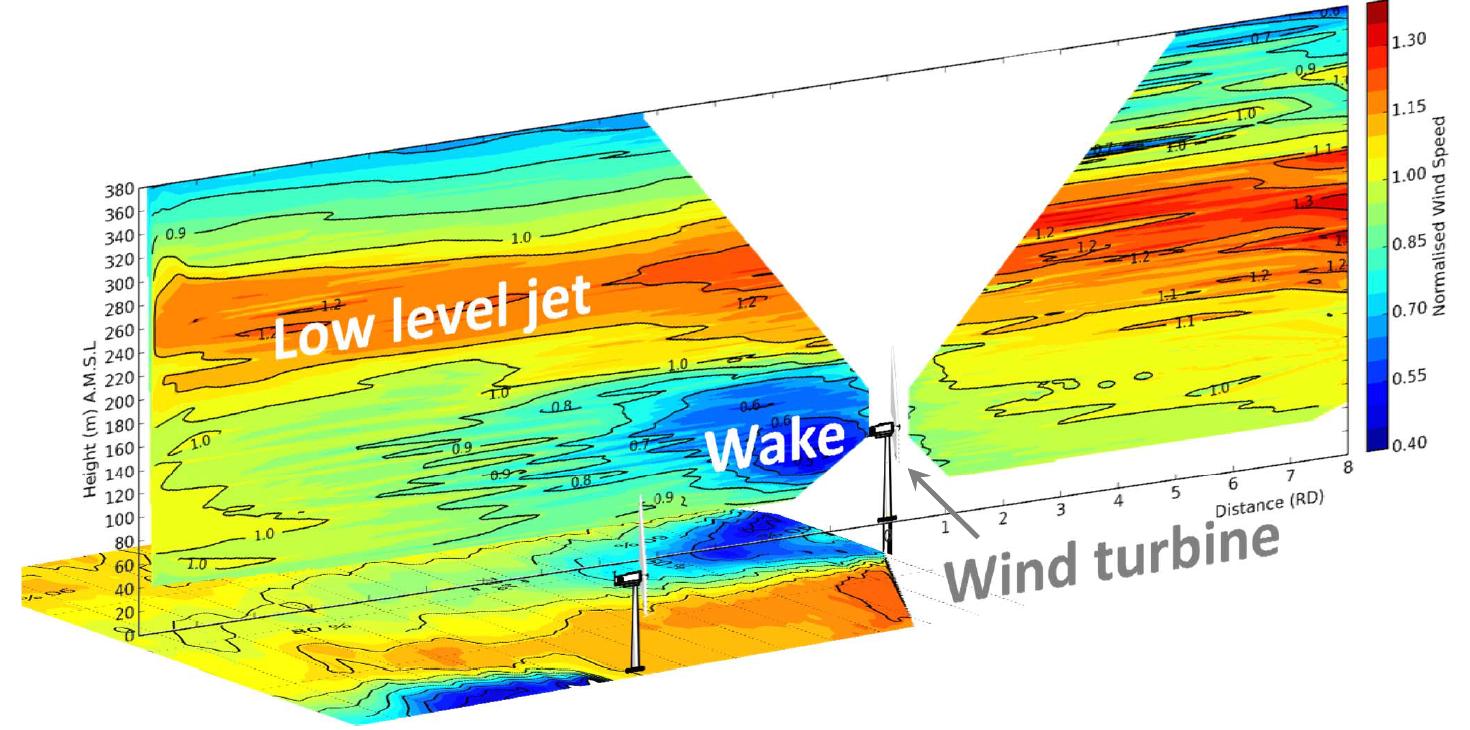
A low level jet is visible in a red band just above the rotor tip. The image is a product of scanning lidar.
A low-level jet, on the other hand, is a highly relevant term in wind energy, because this phenomenon is quite frequent and leads to high wind speeds at night with high wind shear. It can therefore cause high mechanical loads and higher than predicted energy yields.
The typical mechanism for the nocturnal low level jet occurs early at night when the turbulent, well-mixed boundary layer comes to rest after the turbulence production by solar irradiation and thermal mixing vanishes. The lowest levels (about 100m) suddenly decouple from the atmosphere above where a new balance of forces arises. The pressure and coriolis force are no longer balanced by friction and the flow in the layer around 100m or so is strongly accelerated.
A current paper by Stefan Emeis (DOI: 10.1127/0941-2948/2014/0551) states that in northern Germany low level jets occur in 21% of the nights and can reach up to 1.5 times the wind speed at levels of about 1.5 kilometer (850 hPa).
I’m sorry that I could not state my point in one or two sentences (or 140 characters). The bottom line is just, that the use of “low level jet stream” might lead to confusion of some terms that mean something very different.
–Christian Wetzel
Filed Under: News