Editor’s note: The Energy Department released its annual reports analyzing the wind-power industry in 2015, which continued to show rapid growth in wind installations. The U.S. market remained strong last year, thanks to low prices, more-efficient wind turbines, and the fast-growing demand nationwide.
 As Acting Assistant Secretary for Energy Efficiency and Renewable Energy, David Friedman, stated: “Sustained low wind-energy prices and solid growth in installations helped make 2015 one of the best years for our nation’s renewable energy market. These reports show that with more American homes and businesses powered by wind energy than ever before, our nation’s clean energy future is bright.”
Wind technologies market report
According to the 2015 Wind Technologies Market Report released this week by the Energy Department and its Lawrence Berkeley National Laboratory, the United States currently ranks second in the world for wind-power capacity and remains first in the world for electricity generated from wind power.
Total installed wind-power capacity from turbines rated at more than 100 kilowatts in the country grew at an impressive rate of 12% in 2015 and stands at nearly 74 GW, meeting an estimated 5.6% of U.S. end-use electricity demand in an average year. The nearly 8.6 GW of capacity installed during 2015 — representing more new deployment than any other electricity source — is a 77% increase over total installations in 2014.
More than 4,300 utility-scale wind turbines were installed across 64 projects in 20 states in 2015, bringing the total fleet to more than 48,500 operating utility-scale wind turbines in 40 states and Puerto Rico.
 The report also finds that wind energy continues to be sold at attractive prices through power purchase agreements, making this renewable energy source fully cost-competitive with traditional power sources in many parts of the country. In fact, wind generated a total of more than 190 million megawatt hours of electricity in 2015 — enough to power over 19 million average U.S. homes and saving the equivalent of more than 130 million metric tons of carbon dioxide in 2015.
Newer, larger, and more robust wind turbines are enabling significantly greater wind project productivity among new wind projects across the country. The report also illustrates how the U.S. wind industry has positively impacted the American workforce by currently supporting 88,000 jobs related to development, siting, manufacturing, transportation, and other industries — an increase of 15,000 jobs in 2015.
Distributed wind
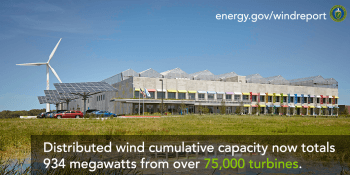
Compared with traditional, centralized power plants, distributed wind energy installations supply power directly to homes, farms, businesses, and communities. In total, U.S. wind turbines in distributed applications reached a cumulative installed capacity of more than 934 MW — enough to power more than 142,000 average American homes — according to the 2015 Distributed Wind Market Report.
This capacity comes from roughly 75,000 turbines installed across all 50 states, the District of Columbia, Puerto Rico, and the U.S. Virgin Islands. Turbines used in these applications can range in size from a few hundred watts to several megawatts, and can help power remote, off-grid homes and farms, as well as local schools and manufacturing facilities.
 In 2015, U.S. manufacturers dominated domestic sales of small wind turbines (up through 100 kilowatts) and doubled exports to 21.5 MW. Between 2012 and 2015, U.S.-based small wind turbine manufacturers accounted for more than $310 million in small wind turbine export sales.
According to the U.S. Energy Information Administration, American wind energy more than doubled from about 95 million megawatt-hours generated in 2010 to more than 190 million megawatt-hours in 2015.
Hydropower has historically been the largest renewable electricity source, but capacity in wind, solar, and other non-hydro renewable sources has grown so much in recent years that non-hydro renewable electricity generation exceeded hydropower generation for the second straight year in 2015. Lower-than-normal levels of rain and snow have also contributed to lower hydropower generation in recent years.
For more information on these two new reports, visit the 2015 Wind Market Reports page. And learn even more about how wind turbines capture energy in this Energy 101 video.
Filed Under: News