
In this article, S&P Global Ratings discussed the development of the green bond market in the U.S., some of the hurdles, how it differs from the European and Asian markets, and the opportunities that await investors as the American grid continues to transform. But underpinning the whole discussion is the torrent of renewable energy that continues to enter the U.S. market. Here, we will take the conversation beyond labelled green bonds to discuss several other factors influencing the growth of renewable energy in the U.S., including renewable portfolio standards, which mandate that power generators use renewable energy sources; production tax credits, which can help finance renewable projects; and feed-in tariffs, which can potentially heighten the demand for renewable energy.
Overview
- Renewable portfolio standards, which have contributed significantly to the growth in green bonds, are mandates by 32 states and territories–but not the federal government–for utilities to sell some electricity generated by renewable power.
- Federal production tax credits (PTC) in the U.S. have helped the level of wind power-generated electricity to quadruple between 2007 and 2014, although the future of PTC beyond 2020 is uncertain.
- Feed-in-tariffs (FIT), which guarantee the price utilities pay renewable energy providers, have yet to gain as strong a foothold in the U.S. as they have in parts of Europe.
- Although Washington is sending mixed messages on renewables, states are likely to continue encouraging their use, especially as the price of renewable power decreases.
Renewable Standards: The forms they take
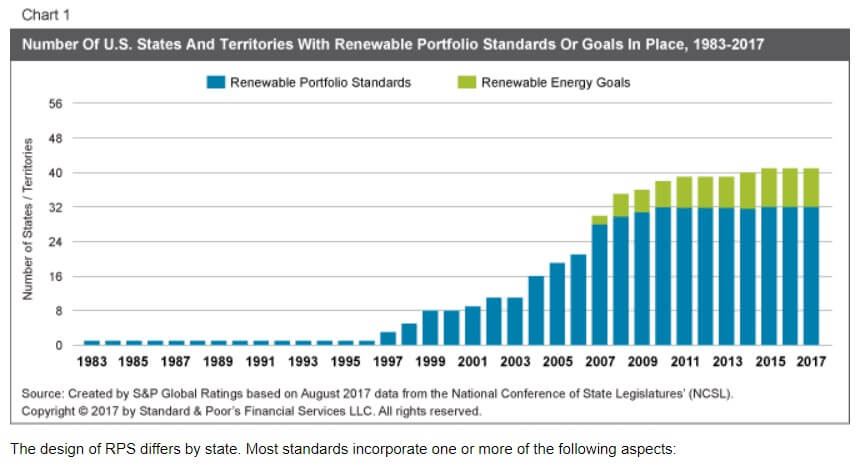
Renewable portfolio standards (RPS) are legally binding policies that require retailers of electric utilities to deliver a specified amount of electricity from renewable sources. Iowa established the first RPS in 1983, followed by Nevada and Massachussets in 1997 (see chart 1). Today, 29 states, three territories, and the District of Columbia have instituted RPS. In addition, eight states and one territory have instituted renewable energy goals, which provide nonlegally binding targets for renewable electricity generation.(1)
Absent a Clean Power Plan or similar carbon mandate, it’s not clear that this tally will be pressured to grow in the near term. But even as the Clean Power Plan has come under siege during the Trump Administration, states having renewable standards have expanded them, sometimes with more ambitious goals and more specific carve-outs for new asset classes.
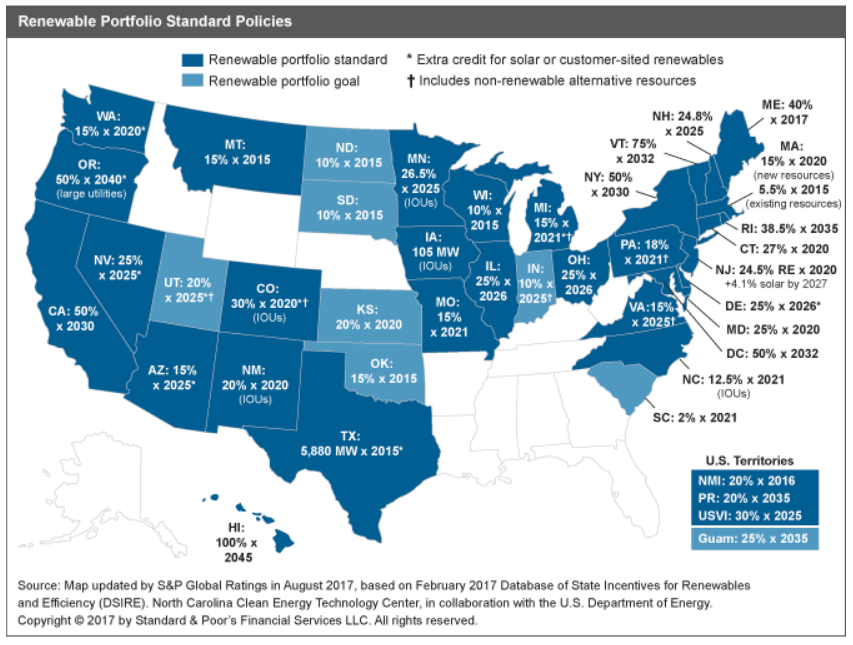
The design of RPS differs by state. Most standards incorporate one or more of the following aspects:
Overall goal
Most often, states set a percentage of kilowatt hours of electric sales that must be generated from renewable sources. Some states diverge from this model, mandating instead that renewable energy sources satisfy a portion of energy capacity or peak demand, for example.(2)
Carve-outs
To encourage the development of specific renewable energy sources, a state may specify carve-outs within the overall renewable target. Carve-outs require a portion of the renewable electricity to be generated by a specific source or method, such as solar, hydro, wind, distributed generation, or energy transformation. States also designate carve-outs for certain classes or tiers of renewable energy sources. The definition of each class or tier varies by state.(3) This could become increasingly valuable as emerging technologies such as offshore wind or battery storage develop, but these newer carve-outs could need technology-specific renewable goals to advance. Indeed, there may be political motivations for such specific mandates–both Maryland and Massachusetts, for instance, have created tailored approaches to offshore wind, hoping to stimulate the industry within their borders, which is still nascent in the U.S.
Applicable sectors
RPS specify whether goals and carve-outs apply to all players in renewable electricity generation or to specific players. Applicable sectors include investor-owned utilities (IOUs), retail suppliers, municipal utilities, cooperative utilities, and local governments. The highest requirements are typically applied to IOUs(4), but, increasingly, municipalities in select parts of the country are creating their own goals to decarbonize, without necessarily being mandated to do so by states.
Credit multipliers
Electric utility retailers in certain states can offset shortfalls in their own renewable energy generation by purchasing tradeable credits. The credits indicate that another retailer has generated an amount of renewable electricity equal to the shortfall. States may promote specific renewable sources through the use of credit multipliers, which permit one unit of renewable electricity to count for more than one credit.
Filed Under: Policy