
AWEA’s Hannah Hunt
Hannah Hunt / AWEA
Have you ever wondered what happens to a wind turbine at the end of its life?
You might be curious – there are more than 52,000 utility-scale wind turbines operating in the U.S. today, providing enough power for 24 million American homes every year. Let’s take a look.
Durable, long-lasting machines
Wind turbines have long life cycles, lasting several decades. Some turbines from the first wind farms built in California nearly 35 years ago still operate today. However, today’s turbines are far superior, and this equipment makes up the vast majority of the U.S. wind fleet– 86% are less than 10 years old.
What happens to a wind turbine at the end of its life?
When turbines become outdated or reach the end of their useful lives, the story isn’t over for the wind farm. There are strong financial reasons to replace older equipment with newer, upgraded technology in a responsible, efficient way.
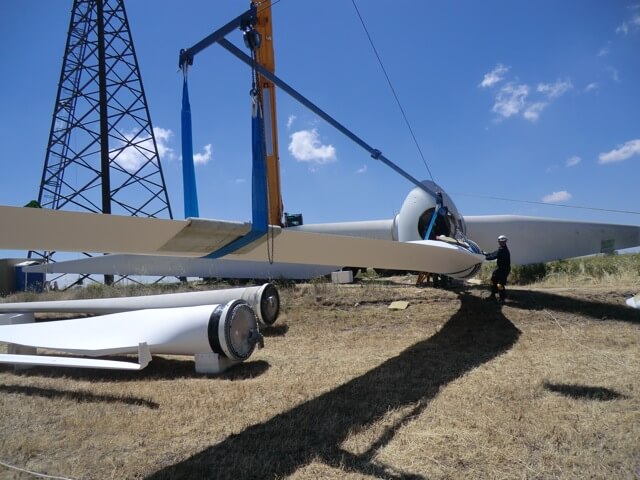
Reblading a wind turbine is one way to give it new life.
Most wind project owners keep the site in use but upgrade turbine technology. Wind farms are built in the best wind resource areas and already have transmission access, providing a strong incentive to replace or refurbish the turbines. And with new technologies providing capacity factors in excess of 40 percent, upgraded wind farms produce more electricity at a lower cost.
In some cases, wind turbines and foundations are completely removed and updated through a process known as repowering. “Repowering tends to become financially attractive, relative to investing in a nearby greenfield site, after approximately 20 to 25 years of service,” according to researchers from the National Renewable Energy Laboratory.
Thousands of older, less efficient turbines have been repowered to date, primarily in California. For example, projects owners recently replaced 1,475 turbines in the Altamont Pass region with just 82 new turbines, providing the same amount of energy and using a fraction of the land. This power is now being purchased by Google Energy and Kaiser Permanente.
Repowering usually leads to cheaper electricity, with savings passed on to consumers. For example, Leeward Renewable Energy has repowered projects in Illinois and expects 30 to 50% cost reductions per megawatt hour to result from using new equipment.
“The benefits of that will flow through to our customers, whether through merchant sales or a long-term off-take partner,” said CEO Greg Wolf.
Maximizing value
In other instances, complete removal of the wind turbine is unnecessary, as the towers, foundations, and electrical cables can be reused. When it makes sense to replace these components, a number of ways to obtain value for the old machines exist. The steel, copper and other metal components that make up the bulk of a turbine can be recycled. Components can be salvaged and used as replacement parts for wind turbines at other sites, or outdated equipment can be sold to isolated locations, like Caribbean Islands, where they’re used for onsite generation.
In short, companies will not leave valuable machines to sit abandoned—market forces ensure they will maximize asset value.
Legal requirements
When a wind project is built, the project owner signs a legally binding contract to lease land for the project from local farmers and ranchers. These contracts typically require removal of the decommissioned turbines. Neither land owners nor the local governments face this expense. Because almost all wind farms are built on private land, this covers nearly every turbine in the U.S.
The process of decommissioning and repowering can bring additional jobs and investment to the local community. U.S. wind power will continue to add tens of thousands of new jobs while investing billions of dollars in local communities, and when the time comes, companies are bound by law and financial incentives to continue acting as good stewards. And that’s what happens to wind turbines when their lifecycles are over.
Filed Under: News, O&M