
By Bjarne Havsteen
Senior Project Manager, R&D
Svendborg Brakes

Over an 18-month period, Svendborg Brakes modified 25 wind turbines, adding the new grooved brake discs on units from several different OEMs. Zero noise has been reported since the upgrades were completed. (Source: iStock/WSS)
Yaw noise is a significant contributor to the noise produced by wind turbines. It is the result of contact between the yaw brake pads and the disc when nacelle adjustments are made to optimize wind generation. The brakes are released to let the yaw motors turn the nacelle sufficiently into the optimal wind direction, and then reapplied to the hold position.
Research has found that there is a direct relationship between the amount of noise caused by the brakes and glazing on the brake pad surfaces.
A word of caution
It is extremely important to correctly diagnose the source of noise during yawing because brakes are only sometimes the culprit. Maintenance engineers should check for oil leaks from the hydraulic power units and yaw bearing seals. Oil or grease found on the brake disc is a problem that warrants a different answer.
The main yaw bearing may also cause turbine noise. What’s more is the brake may fail to release because of an incorrect mesh of the yaw drive gear or the yaw drive gear motor brake. Many of these problems should be recognized and resolved during routine maintenance without the need for special equipment.
The problem with glazing
One problem that’s increasing in the industry is turbine noise generated by the operation of the equipment inside the nacelle. When the nacelle faces directly into the wind, the turbine’s yaw brakes are pressurized to about 160 bar. However, when the nacelle turns, this pressure is reduced to closer to 30 bar. This lets the yaw motors safely adjust the direction of the nacelle without losing control of it.
A small amount of powdered friction material occurs, with a few particles from the disc, because the brakes remain continually engaged. When the low pressure is applied during yawing, some of the powder between the pad and the disc sticks to the pad surface — giving it a glazed appearance. This phenomenon is typical in all types of brakes and is not unique to wind turbines.
The accumulation of powder takes time to develop, so newly installed turbines rarely give cause for concern. Over time, however, glazing may cause excessive noise and problems in older wind turbines.
The groove research
OEMs and independent service providers recently completed an in-depth analysis of glazing and yaw noise. One result based on the research is a patented innovation that solves the yaw noise long term.
Here’s how it works: By cutting a specially shaped groove into the brake disc, it is possible to remove existing glazing and prevent it from re-occurring in the future. The groove poses little threat the brake pad wear and protects the disc from future build-up of the powdered material. It works in conjunction with a brush that’s installed at the same time.
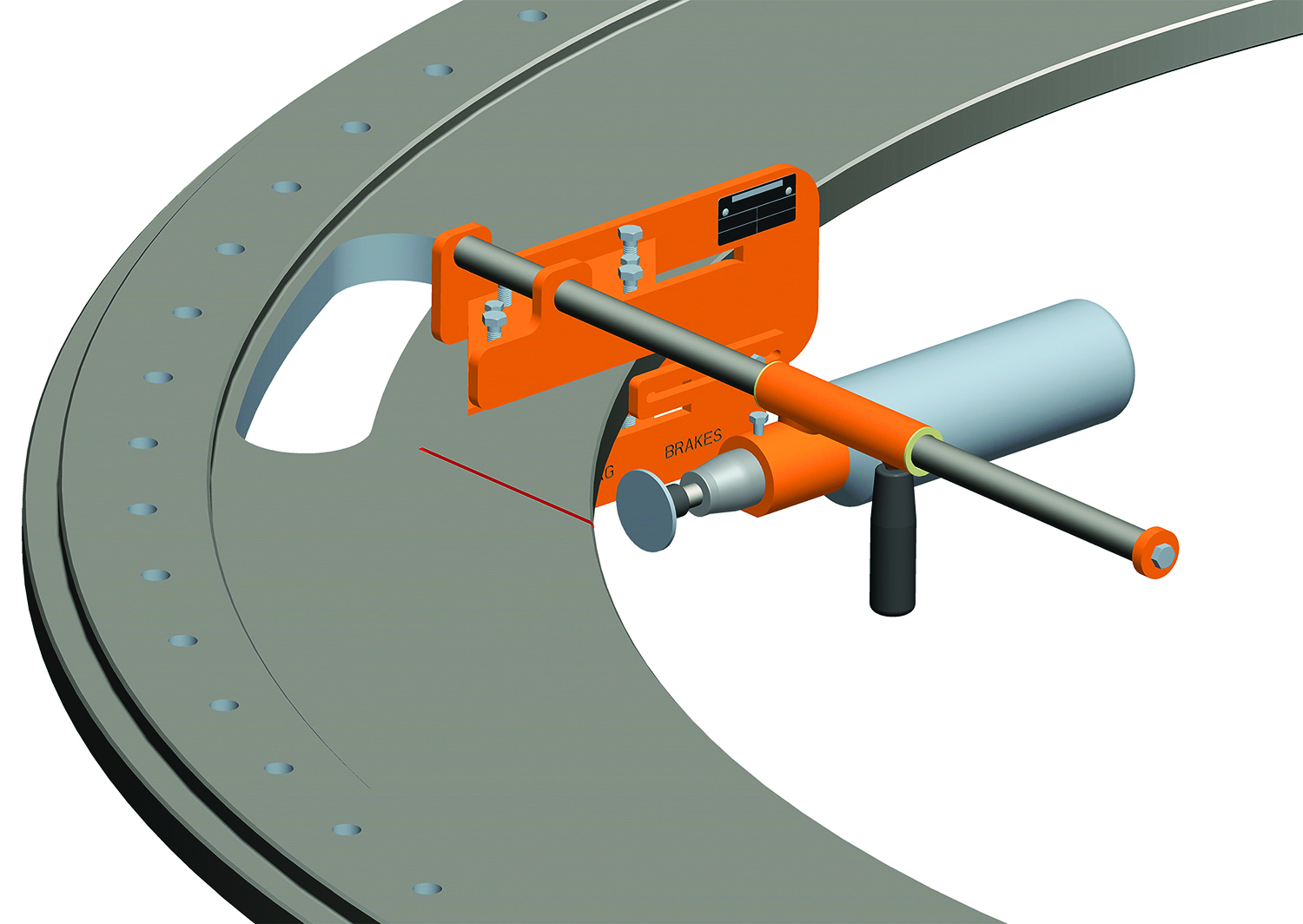
An illustration of Svendborg Brakes’ fixturing template, which lets engineers install correctly sized grooves on wind-turbine brake discs to reduce friction noise.
Tests have shown that grooves cut into the brake disc remove the glazing on the brake pad and increased pad wear by only 3.5%, when operating at a pressure of 30 bar. These tests were conducted using brake pads from Svendborg Brakes, part of Altra Industrial Motion Corporation, that include a slot in the friction material, which ensures the braking surface is clear of debris.
The size and shape of the groove, however, is significant. Testing found that it is critical to develop a system that could consistently replicate the most efficient groove design.
This research has also led to the development of a kit that lets engineers install eight grooves in total, the ideal number. This includes four on the upper surface and four on the lower surface of the brake disc. The kit includes a “fixturing template,” which correctly aligns the groove on the disc. The process takes about three hours to complete for one turbine.
Filed Under: Components, News, O&M