Component design often overlooks the importance of well-engineered seals. Properly engineered seals increase the mean time between component failures, reduce manufacturing costs associated with the use of exotic coatings, and reduce power consumption due to unnecessarily high friction. Data required to select a seal includes:
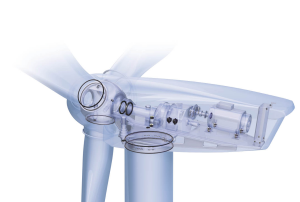
Seals, indicated in black, are used on a variety of bearings in a nacelle. Improving seal function improves the reliability and efficiency of the turbine. -Simrit
• Size – shaft, housing bore, and available seal width
• Temperatures – continuous and maximum
• Application parameters – equipment, sealing surface misalignment to housing bore, dynamic shaft run-out
• Media – type and level of lubricant
• Pressures – continuous and maximum
• Shaft surface speed – continuous and maximum. From these, select either lip seals or isolators.
Lip seals are typically retained in a housing bore by a rubber-to-metal, or a metal-to-metal press fit requiring considerable installation force. Press fits can let metal shavings enter a bore housing, leading to contaminated lube and premature bearing failure. Also, nicks, burrs, or scratches on a shaft surface can damage a seal lip and produce a leak. A mounting tool prevents damage, such as lip roll-over.
By comparison, isolators are easy to install. Isolator seals facilitate the installation and maintenance of sealing systems. They usually have O-rings on their inner and outer diameters to seal on the shaft and against the bore. To prevent damaging O-rings, the sealing surfaces of the shaft and bore must be cleaned prior to installation. O-rings are not dynamic sealing elements so they are not subject to wear. Once equipment is cleaned and inspected, an isolator can usually be installed by hand pressure alone.
Leak detectors (sensors) on some seals measure leakage. (Read more in 1:09 Sensors) Other sealing tasks in a nacelle include:
At the hub where blades pitch: These junctions must be weather tight yet allow rotation. Several designs in a range of materials are well suited for the application. For instance, a form-pressed continuous ring works well on the large dimensions. Its good performance is due in part to a rust-proof tension spring which pulls the seal against a rim. The seal comes in 200 to 1,700-mm diameters. Profile rings for large seal areas are batch vulcanized for advantages over glued rings.
Profile rings come in standard materials and others, and are said to ensure long working lives, low torques, high resistance, and ensure against press-out. They are well suited for sealing large-diameter bearings on pitch and yaw mechanisms. Main shafts: An on-site joined seal concept is said to replace a typical turbine main-shaft seal in less than 30 min and without major disassembly. On-site joined seals claim to offer the same integrity, life, and performance as the seal fitted during manufacture by an OEM.
Slewing bearings: One company has added two more formulations to its line of nitrile butadiene rubber (NBR) sealing materials for grease and ozone resistance, low-compression set, and low-temperature capability. Both materials were developed for long-term reliability and superior resistance to environmental and chemical concerns.
The company says the recent NBR materials offers excellent cold flexibility, good compression set, and demonstrates superior aging in several greases, including Kluber, Fuchs, and Mobil. Recent premium materials are said to provide superior compression set and are optimized for use in Shell Rhodina BBZ greases.
Offshore wind foundations: These provide one of the more unusual sealing tasks for wind power. These are built with structures such as monopiles and tripods. A monopile (single leg) provides an example. After the pile is driven into the sea bed, its top extends up to about 16-ft., but below the water surface. A transition piece, about 80-ft high, is lowered over the top of the pile and will clear the water by some 40 ft. An inflatable grout seal, much like an inner tube, is then fitted in the space between the pile and transition piece. This seal inflates with a few psi to close the substantial gap between monopole and extension. Grout is then pumped into the gap above the grout seal to produce a strong joint. A floating crane then installs the turbine.
Filed Under: Seals & slip rings