Windpower helped tame the Texas heat of 2011
October 3, 2011 by Paul Dvorak
Filed under Transmission, Wind Power News, Wind Power Projects
by Denise Bode, CEO, American Wind Energy Association.

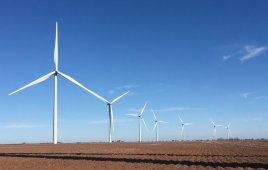
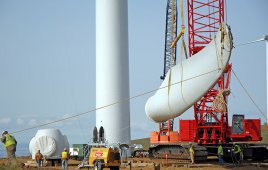
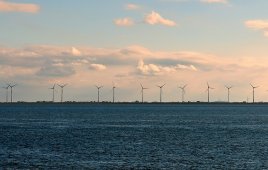
The Horse Hollow Wind Energy Center in Texas boasts 291 GE 1.5 MW units and 130 Siemens 2.3 MW turbines. Turbines like these near the Texas coast were productive during the Texas heat wave of 2011.
In contrast to the comments on some ill intentioned blogs, ERCOT (Electricity Reliability Council of Texas) CEO Trip Doggett credited wind power with a critical contribution during the summer power emergency in Texas. He did the same after a sudden freeze stressed the Texas system in February. Doggett said electricity from wind farms installed along Texas’s Gulf Coast began flowing at just the right time to help meet peak demand in late afternoons. With that in mind, we present a few lessons learned from real-world experience with substantial amounts of installed wind generating capacity on a large utility system:
- Adding wind power makes a utility system more reliable, not less. ERCOT’s Trip Doggett credited wind power with a critical contribution during a power emergency (in the summer of 2011). Doggett said electricity from wind farms that had been recently installed along Texas’s Gulf Coast began flowing at the right time to help meet peak demand.
Balancing electricity supply and demand is a complex task, and utility system operators are accustomed to turning various types of power plants on or off to match demand as it rises and falls throughout the day.
Even though wind energy is variable, it varies slowly–unlike conventional power plants, which can fail instantaneously–and can be a critical component in times of need. For three straight days in the real world, wind made the difference between keeping the lights on and the air conditioners running, and rolling blackouts. - No power plant runs 100% of the time.
Throughout the heat wave, as in February’s (2011) freeze, the Texas utility system was bedeviled by outages of conventional power plants due to extreme weather. According to an August 2 blog article by Elizabeth Souder of the Dallas Morning News, “The high temperatures also caused about 20 power plants to stop working, including at least one coal-fired plant and natural gas plants.”
Souder noted that a spokesman for ERCOT, the company that manages system operations, “said such outages aren’t unusual in the hot summer…”
This is fascinating, since the rap on wind is that it’s not dependable because “sometimes the wind stops blowing.” In the real world, sometimes it also gets too hot or too cold for the supposedly dependable fueled peaking power plants to operate properly. - Geographic dispersal of wind farms makes their electricity production more dependable.
This is something that seems obvious–the wind is usually blowing someplace–and has been predicted by a host of studies. (In the 2011 Summer heat wave) it became crystal clear, as the Gulf Coast wind farms, which provide some 13% of Texas’s overall wind generation, accounted for as much as 70% of the wind-generated electricity provided during peak hours.
The reason for this is that winds are often low in west Texas, where most of the state’s wind farms are located, on very hot days, while ocean breezes blow more strongly.
Generation from offshore and coastal land-based wind matches up well with summer demand peaks.
Again, this is a phenomenon that has been predicted by studies. During a heat wave in the Northeast in July, Cape Wind, the company that hopes to install a large offshore wind farm off Cape Cod in Massachusetts, said its meteorological data showed the project would have been producing at full capacity during peak demand hours.
The Texas experience bears that out, with ERCOT CEO Doggett telling the Austin American-Statesman, “We’d love to have more development of coastal wind. And we’re hoping their ability to generate during the peak hours may encourage more development in that area.”
AWEA
www.awea.org
Oil and gas companies blocking the wind
September 21, 2011 by Paul Dvorak
Filed under Clean Energy Standard, Construction, Wind Power News
The Natural Resources Committee says the Federal government issued only a few dozen permits to develop wind and solar-energy projects on public land last year compared with more than 1,300 oil and gas permits for the same real estate. The low number needs attention fast, say members of the Committee
The culprit, according to many wind and solar industry officials testifying at the recent Natural Resources Committee hearing, is a bureaucratic process that can be used by project opponents to stall plans until they become economically unfeasible.
“I’m shocked at the constant problem of permitting and uncertainty,” said Rep. Jeff Landry, Republican of Louisiana. Also, James Gordon, president of Cape Wind Associates, detailed the permitting process during his experience with what could become the nation’s first offshore wind generation project. The wind project has been clearing hurtles set up by opposing special-interest groups for the last 11 years.
With no legal requirement for the duration of a permit review period, “opponents can use regulatory stalling and delay tactics” to “financially cripple” projects that may meet the necessary standards, he said. “A small group can tie you in knots for years,” said Gordon, referring to a special interest group that he said “has sought to delay the [permit] review process at every turn.”
The Natural Resources Committee has been trying to identify roadblocks to wind and solar energy projects. At its first hearing on May 13, the committee asked directors of the Bureau for Land Management and the Bureau for Ocean Energy Management, Regulation and Enforcement to explain the alleged permitting delays. Those officials said they were working to eliminate redundant steps.
The wind energy industry employs about 75,000 people in the U.S., and the generating capacity has grown annually by 35% over the past five years, “second only to natural gas and more than nuclear and coal combined,” said American Wind Energy Association spokesman Roby Roberts. But despite industry growth, presentors agreed that the major roadblocks of policy uncertainty and a lengthy permitting process remain.
Although federal incentives, such as production tax credits and investment tax credits, have helped the wind and solar industries, current credits are set to expire by end of 2011.
In addition, a $7 billion grant program in the 2009 stimulus bill provided for 2,601 renewable energy projects, “leveraging about $22 billion in private sector investment,” according to Stanford University energy expert Dan Reicher. But if projects have not started construction by the end of 2011, they will lose the money.
Natural Resources Committee
www.naturalresources.house.gov/
AWEA
www.awea.org
Wind rebounds in 2Q, but continued growth depends on consistent tax policy
September 8, 2011 by Paul Dvorak
Filed under Construction, Wind Power News, Wind Turbine Installation

Things are going up in Iowa. In fact, the state reached a milestone of generating 20% of its electricity from wind (January to April 2011), according to EIA. MidAmerican’s new 594 megawatt wind farm near Adair, above, helped reach those figures.
U.S. wind energy continued to rebound in the second quarter, with 2,151 MW of electrical generating capacity installed in the first half of 2011 versus 1,250 MW during the same time in 2010, up 72%. However, analysts at the American Wind Energy Association (AWEA) cautioned that without stable policy such as an extension of the Production Tax Credit, set to expire in 2012, the industry’s recovery will stall.
Project activity and orders for 2013 and beyond are scant because of the lack of a predictable business environment, causing layoffs and even bankruptcies in American manufacturing plants and the supply chain, said AWEA. These struggles for U.S. wind manufacturers will worsen if Congress lets the tax credit expire.
Ironically, due to the Production Tax Credit and market stability over the past five years, domestic content in the U.S. industry reached a record high of 60% through 2010, according to a recent Department of Energy report. “Clearly Congress cannot take for granted all the wind-energy manufacturing and construction jobs that have been a bright spot through the recession,” said AWEA CEO Denise Bode.
However, she added, “Wind tax credits enjoy broad bipartisan support, and since they’re not spending programs, current projects are safe and prospects for extension of the Production Tax Credit beyond 2012 are good.”
The fast-growing wind sector averaged 3.2% of the nation’s electricity over the strong wind months between January and April 2011, according to the Energy Information Administration’s Electric Power Monthly report. For now, wind energy remains ahead of schedule to generate 20% of America’s electricity by 2030, a goal identified by the U.S. Department of Energy under the George W. Bush Administration.
“We’re making more clean, homegrown energy, and prices are more affordable, than ever,” says Bode. A report by energy consumer advocate Mark Cooper, released in May by the Vermont Law School, found that wind energy today is such a good deal it helps hold down overall prices for electricity long-term. Cooper asserted that an American utility would be irresponsible not to invest in such a fixed-price source of power.
An additional 7,354 MW of new capacity was under construction by July 1, more than at any time since the third quarter of 2008.
Since 2007, wind energy has installed 35% of America’s new electrical generating capacity, more than twice coal and nuclear combined.
Meanwhile, the comparative stability in U.S. tax policy has helped to steadily increase the level of content that’s made in America in U.S.-installed turbines, from 25% just a few years ago to over 50% in 2009 and reaching 60% domestic content according to a July 2011 DOE report.

Big under-construction numbers were reported in numerous states. A few include 845 MW in Oregon, 802 MW in California, 769 MW in Oklahoma, and 619 MW in Iowa, where MidAmerican (above) has two other major wind projects underway.
“We’re seeing a strong trend toward insourcing, just when so many American industries are outsourcing,” says Bode. “The Production Tax Credit for renewable energy produces affordable clean power, it increases the American manufacturing base, and adds to the jobs that go with it.”
Other highlights of AWEA’s U.S. Wind Industry Second Quarter Market Report 2011 include:
- The U.S. industry during the second quarter installed 1,033 MW of electrical generating capacity versus 709 MW in the same period last year, up 46% for the same quarter last year.
- California installed the most, with 420 MW; then Oregon, 201 MW; Illinois, 150 MW, Utah, 102 MW; and Ohio, 56.5 MW and its first utility-scale wind farm.
- Maryland added its second utility-scale project, of 50 MW, taking its wind energy capacity up 71%.
- Over 2,500 MW of new construction were started during the second quarter, almost three times more new construction than began during the first quarter of the year.
- Huge under-construction numbers were reported in numerous states: 845 MW in Oregon; 802 MW in California; 769 MW in Oklahoma; 619 MW in Iowa; 611 MW in Illinois; 501 MW in Colorado; and 492 MW in Texas. “Most regions across the U.S. have more under construction activity today than installed in all of 2010,” said Elizabeth Salerno, AWEA’s Chief Economist and Director of Industry Data Analysis.
- Construction began on the first utility-scale wind farm in Nevada.
- Adding a 78-MW repowering initiative in California’s Altamont Pass, where some of the industry’s earliest turbines were installed 30 years ago, brings total construction to 7,432 MW in 28 states, including 17 states with more than 100 MW under construction.
- Further large-scale construction is ahead in Iowa, where financier Warren Buffett is helping bankroll the installation of 258 turbines in five counties with a combined capacity of 593 MW.
- The U.S. wind industry now totals 42,432 MW of cumulative wind capacity, led by Texas with more than a fourth of the total. Amid a worsening drought in Texas that is threatening the large amounts of water needed to generate most other sources of electricity, Bode stressed another advantage of wind energy: it uses almost no water.
- Texas is followed by Iowa, California, Minnesota, Illinois, Washington, and Oregon in total installed wind capacity.
AWEA member companies can access a members-only version of the report by logging on to the member center at awea.org.
AWEA
www.awea.org
Misguided legislation sends jobs to Canada
July 12, 2011 by Paul Dvorak
Filed under Editorial, Legal issues, Wind Power News
By Jeff Anthony, Business Director, AWEA, Milwaukee, Wisc

Jeff Anthony
The Wisconsin Assembly recently passed a bill that would enable hydroelectric power from Manitoba, Canada to be shipped to Wisconsin to meet the state’s 2006 law requiring 10% of the state’s electricity to come from renewable energy sources by 2015.
If enacted into law, the Manitoba Hydro Bill will ship jobs to Canada and reduce Wisconsin’s ability to meet its clean energy requirement by building more homegrown state energy projects.
One of the bill’s sponsors, state Sen. Frank Lasee (R-De Pere), was quoted saying, “This new law will keep electric bills from going up by making it more affordable for utilities to meet green energy mandates.”
Unfortunately, he was mistaken in assuming that other forms of “green energy” will raise electricity rates in the state. If he had gotten his facts straight, he would have found that wind energy costs are at near-record lows, and many U.S. utilities are reaping the benefits of lower electricity rates as wind energy expands on their systems. But the facts regarding wind energy costs apparently weren’t relevant in the rush to pass this ill-conceived bill.

Shortly after the Wisconsin renewable-energy law was hobbled by legislation, Chicago-based wind developer Invenergy said "regulatory uncertainty" has led it to cancel plans for the 150-MW Ledge Wind Energy Center in Wisconsin's southern Brown County.
What Sen. Lasee failed to mention is that his bill will also have a significant impact on Wisconsin by sending good-paying jobs that would otherwise have been created in Wisconsin – to Canada instead.
Sen. Lasee and the other state legislators who voted for the bill would have the state import electricity from Canadian energy projects that use domestic workers. Today, Wisconsin supports 2,000 to 3,000 workers in the wind energy industry alone, and the Manitoba Hydro Bill now threatens many of those jobs.
This is just the latest example of legislative activities that are exporting good-paying, clean energy jobs out of Wisconsin. Why is this happening?
At the beginning of the year, another onerous bill was proposed to impose extreme requirements on potential Wisconsin wind project locations. A few weeks later, a joint legislative committee voted to suspend Wind Siting Rules that had been developed through a collaborative, open, and fair process. This rule was suspended by the joint legislative committee on the very day that these far better new rules would have taken effect.
Combined, these actions have jeopardized about 700 MW of proposed state wind projects, resulting in the potential loss of $1.8 billion investments and two million construction job-hours. Furthermore, those two million job-hours will not show up in Wisconsin, but will likely move to neighboring states.
So what is the next step in the “Wisconsin Jobs Export Agenda?” Another piece of anti-clean energy job legislation has emerged. Assembly Bill 146 would significantly reduce the growth of renewable energy in the state. The Wisconsin clean energy law was originally created to incentivize new renewable energy development and increase fuel diversity. AB 146 would effectively remove that incentive.
The American Wind Energy Association has asked the Wisconsin Assembly not to act on AB 146, and instead reconsider efforts to create and protect jobs in the state’s wind-energy industry.
Today, Wisconsin has a number of thriving and growing renewable-energy businesses, especially in the supply chain and wind turbine component manufacturing sectors. AB 146 would threaten those companies and their Wisconsin employees. Is the state legislature prepared to take further actions to threaten manufacturing jobs that exist today in the wind-energy industry?
If Wisconsin is serious about economic development and growing jobs in the state, it must look to establish a stable environment for wind project developments and for component manufacturing in the state. Turbine manufacturers and makers of major components want to locate factories (and jobs) close to where projects are being installed. States that are “open for business” to the wind energy industry, such as Iowa, Illinois, and Michigan, are reaping the benefits of these associated manufacturing jobs.
Together, the wind energy industry stands united in urging the Assembly to dismiss AB 146 and begin to taking steps to re-establish Wisconsin as a good place to do business for the wind energy industry. The legislature needs to decide if it wants to continue to send jobs out of the state and country, or if it is serious about creating good jobs for workers in Wisconsin.
AWEA
www.awea.org
AWEA 2011 day two recap
May 25, 2011 by Kathleen Zipp
Filed under Turbine Design
With roars from a custom motorcycle and crowd laughter, the Windpower 2011 Conference & Exhibition got underway with a big shot of energy in Anaheim, Calif.
Speaking the opening session was business leader Ted Turner. “I’ve never seen anything more clear as the case for wind, solar, and geothermal,” he said, stating that embracing renewables is even more of an obvious business decision for him today than launching eventual cable giant CNN was in 1980.
Echoing the calls of wind advocates, Turner, who has gotten involved through his Turner Renewable Energy venture, underscored that stable policy incentives—such as those under which other energy sources operate—are essential to the continued growth of wind power. “They must be long-term incentives so we can plan intelligently,” he said.
AWEA CEO Denise Bode arrived at the podium on a custom motorcycle inspired by wind power. Driving the bike was Dave Perewitz, the king of custom motorcycle fabricators, whose Great Biker Build-off series on the Discovery Channel has garnered much attention among bike enthusiasts. (Perewitz, who is working with Allstate to do a motorcycle-safety roadshow, will also be promoting wind power in magazine articles he writes.) Perewitz’s American Wind Power chopper is on display this week in Hall E of the Anaheim Convention Center.
Bode noted the significance of Windpower’s return to California, where the industry began 30 years ago—and where a true renaissance is taking place today, particularly since the state recently passed a nation-leading, 33% by 2020 renewables target. “Thirty years ago, the Golden State gave rise to a new wave in America’s sea of electricity generation,” she said. “It was California’s unabashed vision that made it the perfect breeding ground for the beginning of the American wind energy development. Today, 30 years after those wind farms first appeared, the Golden State is once again challenging the nation, leading the charge.” Turner, who participated in a Q&A format with Bode, provided insights into what America needs to reform its approach to energy.
Also, Bode took the opportunity to give AWEA’s Champion of Wind award to Rep. Earl Blumenauer, a long-time wind advocate. Blumenauer spoke eloquently on the wind industry’s needs. He said to get America on the right path for energy, “Step No. 1 is to get the Production Tax Credit extended,” referring to the industry’s primary policy driver through the years, which expires at the end of 2012.
The story of the tax credit epitomizes the short-term policy approach that the industry has had to endure. It generally has been extended in one- and two-year increments, and even been allowed to expire before getting extended again. Wind advocates seek a long-term extension to provide the industry a predictable business environment so it can stay on track to produce 20 percent of America’s electricity by 2030, the goal identified in the Bush Administration.
Meanwhile, providing his own brand of enlightenment was Montana Gov. Brian Schweitzer. He used Montana ranch-style anecdotes to describe the imperative for America to increase its energy independence. Schweitzer also compared the growth of domestic energy to the Apollo program to reach the moon and referenced Tom Brokaw’s book, the Greatest Generation, on the contribution made by Americans during World War II. ”The question is,” said Schweitzer, “can we be the Greatest Generation?” To become another such generation, he suggested, the nation must tap its own vast resources to develop clean, affordable American wind power.
At a press conference held at the conference, participants and other stakeholders turned their full attention to Bonneville Power Administration’s decision to take enough wind power off the grid in the past week to supply 160,000 homes for a week.
Just days away from WINDPOWER 2011, wind generators in the Pacific Northwest began seeing the Bonneville Power Administration (BPA) break its contracts with them, because of what AWEA and the wind industry termed a wrongheaded decision that BPA announced May 13. BPA claims it can cut off wind’s access to customers at will, change wind generators’ contracts and abrogate BPA’s own transmission agreements, even though less costly alternatives are available that BPA has chosen to ignore.
“No one is above the law,” said AWEA Senior Vice President of Public Policy Rob Gramlich, speaking at the WINDPOWER press conference. “No one can break contracts as Bonneville has. Commerce cannot exist without contract sanctity.”
Explaining that the BPA move is a “damaging precedent that will kill investment,” Gramlich likened the federal utility’s action to an air traffic controller that owns airplanes and is letting only its planes land.”
“Bonneville Power is calling this a wind power vs. salmon issue,” said Pat Ford, executive director of Save Our Wild Salmon, speaking via conference call at the Windpower media availability. “That is wrong factually, and also the wrong approach if the goal is solutions that work for people, salmon, and West Coast economies.
Furthermore, with the auto industry officially having entered the electric-car era, the connection between wind energy and transportation took concrete form at Windpower 2011. An electric vehicle from Tesla was on display, shimmering in the California sunshine in front of the Anaheim Convention Center as conference attendees passed by.
The opportunity to wind-powered your car has arrived. Several automakers, including American icons Ford and Chevrolet, are rolling out electric and hybrid vehicles. That would be a good thing for consumers’ wallets. Driving today costs over 15 cents a mile for gasoline, while running an electric car on wind power costs less than 3 cents a mile. That’s like paying 70 cents a gallon at the pump, saving you over $1,400 a year (based on these assumptions: price of gasoline, $3.50/gallon; average miles per gallon 22.5; average miles driven per day, 32.)
AWEA AWEA.org
AWEA 2011 day one recap
May 24, 2011 by Kathleen Zipp
Filed under Turbine Design
My feet are tired and my eyes are heavy, but I feel satisfied with a successful day at AWEA 2011. The floors were full with companies eager to talk about the wind industry. Yes, it’s true project growth may be slowing down, but conversation is picking up. Today I got a lot of feedback about some of the major issues the industry is facing.
For one, with more turbines coming out of warranty, operations and maintenance is becoming a huge focus for many wind farm operators. Furthermore, regardless of warranty periods, the industry is always looking for ways to reduce operation and maintenance costs and thereby increase wind farm reliability, productivity, and profitability.
One company, Bronto Skylift, is helping to reduce costs through their 112-m aerial model, the world’s largest. This takes only about 15 minutes to set up, thereby reducing maintenance time and cost. Another company, Moog, also offers electric motors for turbines that have longer lifespans and require less maintenance. Lastly, 3TIER has developed a risk management system to give banks and investors a better idea of what projects are likely to be the most successful.
Over all, the show’s many exhibitors in their modest to exquisite booths conveyed that while the wind industry has slightly slowed in growth, the thinking of its players has not. There are many new ideas out there that will help reduce costs, while increasing efficiency and reliability. And that gives me hope that the wind industry has the strength to bounce back and grow much more yet.
Current industry weak but outlook strong
May 5, 2011 by Windpower Engineering
Filed under Editorial, Policy
Each spring the American Wind Energy Association (AWEA) releases their annual wind-energy report outlining the state of the industry for the prior year. This past year was the first that’s seen declining growth since 2007. But, as the report points out, we still have some things going for us.
In 2010, the U.S. wind industry added 5,116 MW to the national electricity portfolio, an increase of 14.6%. While this is typically considered strong growth for an industry, the number pales in comparison to the 10,010 MW and 40% growth the industry saw in 2009. However, politically and geographically, wind power is gaining ground. There are now 38 states with utility-scale wind turbines installed in their borders—36 of which have renewable portfolio standards or goals.
Furthermore, wind-power generation throughout 2010 provided 2.3% of the nation’s electricity, an increase from 1.8% in 2009. While this may seem like a paltry number, it represents significant growth and support for renewable energies, which as a whole produced 10.3% of the U.S. electricity supply.
This last decade has seen tremendous growth in wind-power capacity. In 2000, over 60% of the U.S. wind-power capacity was clustered in just one state: California. Now, with 38 states involved, the U.S. boasts the second largest capacity in the world with 14 states above the 1,000 MW mark. A main contributing factor to this growth has been efficiency increases in technologies. For example, in 1990, not only did a typical turbine have a nameplate capacity of only 250 kW, it performed with relatively low capacity factors and availability. Over the last two decades, the technology has improved to the point where availability to generate is usually above 98%, while taller towers and better siting technology have enabled most project owners to achieve capacity factors in the range of 30 to 40% annually. This means that a turbine with a nameplate capacity of 1.75 MW, or seven times larger, can produce as much as fifteen times more electricity.
In addition to a strong installed capacity of wind-generated electricity, as 2010 came to a close there were over 5,600 MW worth of wind projects under construction in the U.S. That’s more than double the 2,750 MW that were under construction going in to 2009. Now, admittedly, the original deadline of the ARRA 1603 cash grant had some effect on these numbers, but not as much as you might think. AWEA reports that only 2,500 MW were initiated in the fourth quarter, indicating that the other 3,000 MW were likely scheduled to begin construction in 2010 regardless.
Supporting these projects, the U.S. financial sector delivered roughly $11.1 billion in project debt and tax equity deals throughout the year. The 20 tax equity deals struck last year amounted to $2.7 billion and supported about 3,800 MW of increased wind-power capacity. Also, with $8.4 billion invested in debt capital, 29 new deals were struck—delivering nearly 5,600 MW. An additional $820 million, supporting over 600 MW, was raised in 2010 but did not close before the calendar year end.
All of this growth in the wind industry has led to substantial growth in the manufacturing sector as well. In 2010, the United States employed about 20,000 workers in wind-related manufacturing across 400 facilities. Similarly, employment in permanent operations and maintenance jobs expanded during the year to help run the nation’s inflating wind-power fleet. Overall, even with substantial economic headwinds, the U.S. wind industry was still able to support 75,000 direct and indirect jobs in 2010, down from 85,000 in 2009.
To sum up the report in a few sentences, the wind industry in the United States is growing, and growing strong. We have some of the best natural wind resources in the world and we are just recently beginning to utilize them. State and federal policies are slowly but surely tilting in favor of wind energy. As these policies are implemented on a more consistent and long-term basis, the growth of the wind industry will grow stronger and faster than before. We truly have a lot to look forward to.
WPE
AWEA reports industry growth in Q1 2011
May 3, 2011 by Kathleen Zipp
Filed under Policy
AWEA reports that America’s wind power industry installed 1,100 MW of new capacity in the first quarter of 2011 alone, and entered the second quarter with another 5,600 MW under construction. The under-construction figure is nearly twice the megawatts that the industry reported at this time in both 2009 and 2010; moreover, two-thirds of those megawatts are already locked in under long-term power purchase agreements with electric utilities, indicating an enduring industry that has proven both nimble and strong through a range of economic and policy conditions. The total wind fleet now stands at 41,400 MW—producing enough clean energy to supply 10 million American homes.
“American wind energy is ramping up, and these first-quarter figures indicate an industry poised for a renaissance. Refined technologies, affordable prices, and continued demand for clean, homegrown energy—these are all reasons why wind has consistently posted strong growth numbers, adding 35% of all new generating capacity since 2007,” says Denise Bode, AWEA CEO. “In an economy in which gas prices have hit $4 a gallon and are still on the rise, America must implement long-term energy policies centered on homegrown sources. And wind delivers. By powering our electric cars using wind, Americans can pay the equivalent of 70 cents a gallon at the pump.”
The first quarter’s 1,100 MW of new capacity came online in 12 different states, with some seeing double-digit growth. U.S. states with the most capacity additions so far include: Minnesota (293 MW), Washington (252 MW), Illinois (240 MW), Idaho (119 MW), and Nebraska (81 MW).
Of the 5,600 MW currently under construction, one third is located in Oregon, Washington and California, making the West Coast a leader in wind project activity. “States continue to lead the nation with clear, strong policies,” says Elizabeth Salerno, AWEA’s chief economist. “For example, 10 years ago, California led the nation with 60 percent of U.S. wind capacity. With the recent passage of the strongest renewable target in the nation—calling for 33% renewables by 2020—California is poised to retake its leadership, as it already had over 600 MW under construction in the first quarter.”
AWEA www.awea.org
AWEA Wind Power Supply Chain Workshop: Supplier Case Studies
March 24, 2011 by Kathleen Zipp
Filed under Turbine Design
Component Supplier – Case Studies
Moderator: Ed Watson – Great Lakes Wind Network
Panelist:
Charlie Appleby, Manager of Client Services, Arkansas Manufacturing Solutions (AMS)
Alexandra Altvater, Dir. Business Development, Beckmann Volmer
Chris Carpenter, Business Development Manager, Flash Technologies
Carl LaFrance, VP Renewable Energy, Molded Fiber Glass Companies
Dennis McKinley, Industry Sales Manager, ABB
Q&A
-Q1 How did you enter the Windpower market?
- A1: Carl: Innovative foresight back in 1970′s from GM in Calf. plant. Took a while to payoff, but certainly a good decision
- A2: Emerged from European Counterparts…easy transition from existing telecom and airport business
-Q2 Who has a Lean Manufacturing Process
- A – everyone on panel
- Q3 How important is co-location with customers when opening supply manufacturing facility?
- A1: Carl – it is certainly a factor that we consider. We bring in very small parts but our finished product is very large, so in order to keep logistical time and cost down we try to locate near our customers are easily accessible transportation route.
- A2: Alexandra – Very important…actually entered wind market because of close proximity to GE Energy in Germany. Opening Arkansas plant because of location to Nordex facility in Arkansas.
- Q4 How often to you redesign your products?
- A1: Alexandra- Always looking to innovate but most changes stem from customer request.
- A2: Carl – Throughout the entire lifecycle of the product line. Rely on customer insight into what is needed for innovative change.
- A3: Dennis: By customer request
- Q5 What keeps you up at night?
A1: Dennis- What is wind market doing today? Uncertainty in market.
A2: Carl- Lack of longterm US policy in wind.
A3: Chris- No Stable policy for wind.
A4: Alexandra- Unknown market, lack of strong US policy for wind. Manufacturing leaving US for China and others.
AWEA Windpower Supply Chain Workshop – State of Wind Turbine Manufacturing
March 24, 2011 by John Wtwh Currid
Filed under Turbine Design
Moderator: Dan Radonski – Kinetic Partners
9:15a – Ralf Sigrist : President/CEO Nordex USA
- Arkansas legislator is voting on a cap for amount of Windpower to add into utility. Argument is it will drive cost of overall energy up. Want to cap at 5MW down from 50MW.
- North America represents 25% of overall Nordex annual revenue.
- 162 MW scheduled Nordex installations in 2011
- 75% of US installation contains domestic components.
- Raw material and component cost increase to Nordex for domestic components is up 25%
- Long-term costs for wind is in ongoing maintenance. Instance of this cost: raising crane for repairs is $200k daily- just for the crane.
- Quick on hand and turn around is key for domestic suppliers to compete for Nordex business. Right now in many cases even with significant logistic costs, components are trending cheaper coming from China.
- Other major issue for supply chain for OEM Manufacture is longterm cost stability. Nordex has to guarantee cost in a bid to sell turbine for minimum of 12 months. Component Suppliers and steel producers want to shorten to 30,60,90 day for their cost guarantees…doesn’t add up.
9:40a – Stephen Spethmann, Dir. Supply Chain – Suzlon Wind Energy.
- 2011 looks pretty slow for new installations for Suzlon.
- Growth potential is in O&M…5 key customers require 24/7 support. Looking to grow this in US.
- Small presence in China, but India is booming!
- US market is growing for Suzlon. 2500. MW installed at end of ’10.
- After acquisition of REpower in 2009, the combined installation makes them 3rd in market share. Companies run some what independent. Supply chain opportunity for entire market though.
- Finance markets lending & component technology will drive or stifle Windpower market.
Supply Chain Opportunity &Challenges/
- Towers: delivery cost and logistics are main issues.
- Blades: innovation, material, & logistics
- Drivetrain & Generator: Permanent Magnet opportunity, Copper Costs are unstable, unexpected downtime is a killer for O&M.
- key for both opportunity is keep costs down, quality up, & have supply on hand and you get the business!
- Supply on hand is key…”Don’t let a Penny hold up a Dollar”…a bearing, gear, or blade might be cheaper and better but if supply holds up manufacturing or repair then it will be over looked in overall supply chain.
10:00a – LM Wind Power
- Supplier of Wind Turbine blades
- also had O&M operation as well as a Brakes division.
- 3 manufacturing facilities in US. Two in Arkansas and 1 in ND.
- Supply all major OEM
- Trends in blade business: longer lighter blades, larger blades, more efficiency that drives turbine.
- US Supply demand is uncertain through 2014…forecast as level.
- USA Offshore potential of 4GW through same time period (2014)
Q&A
-Q1 – What has changed or biggest challenge in Supply Chain to OEM?
A- Ralf Sigrist : 3-5 year order guarantees are thing of past. Supplier needs to share risk with OEM. Also it’s ridiculous to only offer 1 year warranty for a part that is supposed to last 10-20 years.
-Q2: With a saturation of OEM manufacture compared to market size, how important is innovation from both OEM & supplier?
A- Ralf: we are always looking to innovate when it makes sense. We won’t innovate just to innovate though.